2.4 Rowing down the Yukon

March 16, 2012


When I talk to friends about Hayes Perkins, this Alaskan adventure is always one of the first stories I tell:  nine hundred miles down the Yukon River in a row boat in twelve days.


July 7 1908 – July 19, 1908 (12 days)

If you are stuck at Fort Gibbon in the center of Alaska, 900 miles from the mouth of the Yukon, without enough money for fair downriver to St. Michael where you can catch a steamer to Seattle, no job, surrounded by a thousand unemployed men, what do you do?

To begin with, find a companion.  Hayes found Feodor Romanoff, a Bulgarian with soft hands who “says he has a good education, does not need to do physical labor.  He has no other outfit than a small leather handbag, and in this are cosmetics such as a lady has in her boudoir.  Small sort of puff balls, powders and perfumes.”

Then a boat:  Four prospectors pull up in a rowboat from White Horse looking to sell cheap so they can get inland to the diggings fast.  Hayes’ assessment? “Our boat is seaworthy, though rather clumsy.  She is the product of the small shipyard at White Horse….  She is constructed of whipsawed lumber, strips of kerosene tins nailed over the moss filled seams.  She does not leak, and strangely runs well for so heavy a craft.  One oar is hewn out of a spruce limb, the other is a straight stick with a piece of lumber nailed to it.  All round I am satisfied with the boat.”
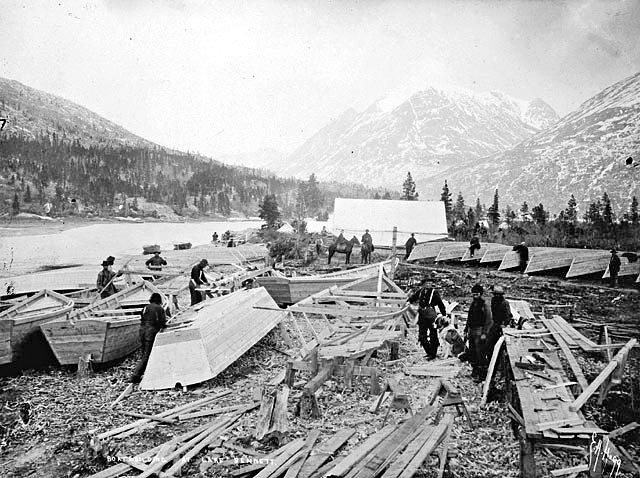
Lake

Lake Bennett Boats

And provisions:  The miners were in a hurry; Hayes worked them a little.  Five dollars bought the boat, together with, “twenty pounds of flour, eleven pounds of bacon and two pounds of prunes.  A coffee pot, a frying pan, two tin plates, some knives, forks and spoons.  What more does a man want on the Yukon?”  Well, Feodor had his cosmetics bag and Hayes had a change of underwear and two blankets.

One of the blankets and a stick found on a gravel bar make a passable sail and the journey starts fast:  140 miles to Kokrines in “eighteen hours and twenty minutes, actual timing.”  Of course Feodor’s hands won’t let him row more than an hour even if he did know how, but Hayes teaches him to steer with an oar when wind fills the sail, so Hayes can get a little sleep.  “Feodor does not realize the seriousness of our position.”  Not yet anyway.

Between Bennett and Lindeman Alaska; not exactly the right place, but the right image

Ten miles below Nulato, 290 miles below Fort Gibbon, out “two days and ten hours,” the wind whipped around to the west (head on) and chopped the river rough as open sea.  Hayes and Feodor put in to a small native village trying to buy some fish.  Hayes, Feodor and the native men find they have only the word “hooch” in common.  “We had none, and they lost interest.”  But a woman from the village who had learned English at the native school at Holy Cross approached with two small children suffering from “the hordes of mosquitoes.”  Hayes gave her some carbolic salve and, when she asked if they had anything to read, could only offer some Salvation Army tracts a man gave him at Fairbanks.  Attention to the children bought them a load of fish, “that we accepted with thanks, but threw over the side when we turned the first bend.”  Cultural differences on how long fish remains edible.

Hayes describes the mosquitoes as truly ferocious.  Here is the once daily drill with the flour and bacon:  “I take the oars and drive for a (sand) bar at full speed.  Feodor stands in the bow, and when the boat strikes the sand, he leaps out, runs to the drift with a bundle of birch bark in his hands and has a fire going by the time I have moored the boat and got the grub box ashore.  We light several fires as quickly as possible, fighting mosquitoes the while.  Then I fry bacon and flapjacks and make a spot of coffee, which we eat while sitting in the smoke.  Then, after cooking enough for the rest of the day we get more bark for the next stop, take the grub box and run for it again.”  Out in the middle of the mile wide river, the mosquitos aren’t so bad, “and when the wind blows we escape them.”

The sun sets for a couple of hours each night but never to darkness.  Feodor is afraid of the Northern Lights; Hayes is afraid of the empty native villages they pass one after another.  He writes, “hooch peddlers float down the Yukon each spring behind the ice.  Then they can sweep up the furs in every Indian village and encampment…  The bootlegger has done his work well.  Selling all their furs to buy booze, there was nothing left for flour and other provisions, so they starved when winter came.”

Above Kaltag, Hayes and Feodor pull ashore at another village escaping the rain.  A native family takes them into a fine cabin (abandoned by woodcutters) but won’t sell them salmon for money.  Furthermore, “something about our appearance aroused their mirth, for without any movement on our part the three boys of the family would laugh loud and long.”  In this instance, a stitch kit was more valuable than money.  Hayes fixed a pair of shoes for a young woman then gave her the tools.  She reciprocated with a well-cooked salmon dinner.

Below Anvik, they meet a priest, “a humble man, living with the Indians as one of them” who could interpret for one of the elders:  “When the Russians were here, they brought us good clothing and other goods, but the price was very high.  Now the Americans bring us poor material, and the price is still high.  The Russians brought no hoochino, but the Americans have ruined our people with it.   During the Russian occupation we were many.  There were four people then to where there is one now.  In a few years we will all be gone.” (Hayes’ quote.)

Now that Feodor’s hands are hardened to rowing, Hayes thinks about making a smudge to keep the mosquitoes off – Maybe a little later, Feodor rows better when he has to move to keep the bugs off.

July 15, eight days on the river and precious little flour and bacon remain in the grub box.  Hayes hears a beckoning from shore and pulls in to find a grey-haired prospector who leads him to a tent where his once gigantic friend lies withered and broken.  “During the previous winter he had been frozen, his feet are now black and gangrened.”  Hayes’ admiration for these hardy men merits exclamation marks:  “But with splendid spirit his partner has cut wood and is trying to sell this [to passing steamships] to pay their passage to the states.  No seeking relief for these self-reliant men!  They are trying against almost hopeless odds to pay their way as they go.”  Despite Feodor’s protests, Hayes leaves half the flour and bacon with the two prospectors.  “It is the right of any prospector to ask for food, for he may be asked himself under the same circumstances.”  Hayes also left the last of the Salvation Army literature with no recorded complaint from Feodor.

Hayes and Feodor left the two prospectors shorter on food but longer on information.  “We were soon in the maze of the delta channels after passing Andreafski, which is 180 miles above St Michaels (sic).  It was fortunate we met the two old miners, else we would never have know which way to go.”  Following the miners’ directions they came to a group of Eskimo men fishing.   One wanted passage north to an Eskimo camp at the Pastolik River mouth for which he eventually paid “a splendid king salmon.”  Perhaps more importantly, the local man showed Hayes a path to the end of the Yukon on the Norton Sound.

The Eskimo men let Hayes and Feodor rest in their shaman house, sold them half cured salmon they’d put up for the dogs and offered them a kind of mulligan stew made from all but the tail and wing feathers of some wild fowl boiled in seal blubber.  “Neither of us could force it down.”  The locals had better food but apparently Hayes had a gold-filled tooth that lead them to believe the two travelers could pay more handsomely than they would.

After more than 800 miles down the Yukon, only forty miles separate the mouth of the Pastolik from St. Michael – forty miles of open sea.  “It has been the worst passage I have ever made.”  A lull had come to the previous day’s storm but the wind freshened immediately after their small boat crossed the “rough bar.”  Hayes hoisted their blanket sail while Feodor lay helplessly seasick moaning in the bottom of the boat.  “The wind blew stronger as we kept on.  Billows broke about us, over us, and for a time I managed to get the now desperate Feodor back to man the steering oar while I bailed for life.”  After 13 hours at the oars, the blanket sail, and the bailing bucket Hayes spied a tall pole “some kindly hand” has placed showing where to tuck safely in behind Egg Island.  Safe from the storm but completely lost:  “Channels, one after another, lead off here and there, and we wonder whither we are going.”

Fortunately the two lost adventurers stumbled across one more kind stranger who knew the river.  In return for the last sweepings from their flour can, the head of a native family gathering berries drew Hayes “an accurate map of our route, placing all the false channels and drawing a line across each.”

After one more short stretch rowing on open sea, Hayes drove hard onto the sand at St. Michael where, “Feodor leaped ashore and without a word cleared up town.”  Hayes sold the boat (“I had gotten a real affection for our boat, a clumsy craft on whose bow someone had inscribed ‘Mary Ann of White Horse’”) for two dollars, gave away their gear, then went looking for Feodor, former half-owner of the Mary Ann, “and gave him his buck.”


2.3 Dawson to Fort Gibbon

March 11, 2012

I’ve included two maps this week.  The first shows this episode with Hayes traveling down the Yukon river into the very center of Alaska where he finds a brief bit of work.  The second shows his path in the previous 18 months.

June 17, 1908 – July 5, 1908

Hayes seems to have been on a sightseeing trip rather than seriously seeking work up the Yukon.  Still, he’s got to find a paycheck somewhere; the price of food alone has flattened his purse.  A moose steak dinner costs a dollar and the least meal is fifty cents, “and I have eaten no higher.”

With Dawson “rapidly fading into a ghost city” of no more than 3,000 people where 35,000 bustled ten years ago, Hayes decides to press upriver to Fairbanks, “despite the rumors I hear it’s futile.”


Dawson City 1908

At Fort Yukon, the river winds briefly north across the arctic circle so, “It is midnight, yet the sun is shining.  It is low on the horizon, and for fifteen days does not go below the horizon.”  Their stern-wheel steamer Sarah, “one of three great river boats, the Susie, Sarah, and Hannah,” makes slow progress in this sixty-mile wide swampy portion of the Yukon River where a boat could easily be lost.


Stern-wheel steamer Sarah

“Somehow one feels depressed and gloomy by the magnitude of the river.  It sweeps silently and forever onward, as relentlessly as the progress of the sun.”

Bending south below the Arctic Circle, the Sarah arrives at Rampart:  “Just another Yukon town.  A mile long, one street wide, many dogs, a few women, many ragged men who show the signs of hardship and the toil of futile seeking after gold.”  Hayes estimates that not one man in 500 will leave Alaska with more money than he took in.  “So it will be with me doubtless, but the experience no one can rob me of.”

At “Tanana, or Weare, or Fort Gibbon, take your choice and call it what you like,” Hayes describes the river as “lacustrine.”  Somewhere along his rough and tumble life he learned some big words.  Tanana is the end of the line for the Sarah; she’s too large to navigate up the smaller Tanana River, tributary to the Yukon.

By 1908, Fairbanks had replaced Tanana as center of trade for this region.  The mining at Fairbanks remained active but deep: “From fifty to 160 feet overburden, then the pay streak in gravel three or four feet in depth.”  Even in summer the ground never thaws more that three or four feet deep so the miners force steam pipes through the “frozen muck” to reach the gravel pay streak. “It is said that at Fairbanks one mine put a shaft down 600 feet and did not get through the ice.”

Pay is $2.25 for a ten-hour day running crouched over a wheelbarrow of steam-thawed gravel in a low ice-tunnel more than fifty feet underground.   About 3,000 men work the mines with 2,000 idling about town and more arriving on every boat from the south.  The mining company placed the “flattering advertisements” Hayes saw in Seattle to achieve precisely this end:  lots of unemployed men each keeping a man with a job working at top speed.  Passage back to Seattle from Fairbanks, overland in winter or by river in summer, costs $125.  Hayes doesn’t say how much he has in pocket but it’s not $125.

June 28:  “No job, no chance of a job.”  Except… “There is a river steamer here, the Relief, and I have asked the mate for a chance.”  The mate replied, “Nuthin’ doin!”  (Hayes’ quote.)

Pulpit rock
Stern-wheel steamer Relief

Still, “inside advice” says the Relief is short a man.  Hayes is determined that man will be him.  In the meantime, he observes the locals: “pimps, gamblers, prostitutes, musicians about the dance halls, prize fighters, politicians and other shady characters,” all living off the toil of the 3,000 men behind the wheelbarrows.

July 1:  Hayes got the job on the Relief steaming back down the Tanana River to Fort Gibbon/Tanana/Weare.  His protestation, “Look here, I’m a sailor!” (Hayes’ quote) finally elicited from the mate, “All right, I’ll try yuh out.  If you’re no good, I’ll fire yuh at Gibbon.”  Competence as a sailor won’t be the issue; cases of whiskey almost entirely fill the cargo hold of the Relief – Hayes will be expected to unload it all at Gibbon.

The mate’s surprised reply when Hayes explained his unwillingness to handle alcohol?  “Why I’m a Christian, and I handle booze.”  At Gibbon, Hayes wrestled all the general cargo from the hold, refused to lift the whiskey, locked eyes with the mate, gathered his belongings and walked ashore with no word exchanged.  Half a dozen men jumped for his place, the mate chose one, and the Relief steamed out of sight round a bend in the river leaving Hayes high and dry 900 miles up the Yukon.


2.2 Holtville to Dawson

March 4, 2012

Once Hayes got his health back working in the American west, the old wanderlust grabbed him again.  Though he knows the Alaska gold rush is played out, in the spring of 1908 he decided to go up and see the country for himself.  By June he’s at Dawson halfway down the Yukon river in the heart of Alaska.

Once again, the length of the map of his travels in eight months is remarkable.  Click on the title of the post to go to the site.

October 16,1907 – June 14,1908

Today, flat rectangular fields checker the Imperial Valley where the Colorado River feeds some of the most productive agriculture land in the world.  Every drop of the river finds its way to one of the squares on the board; none reaches the sea.


Imperial Valley, California

In 1907, the Imperial Valley rose and fell in hummocks cut willy-nilly by flash floods seeking the Pacific Ocean.  Hayes and his mule team driven four abreast had a small hand in leveling this vast desert filled by “sands gouged out of the Grand Canyon.”

Print of section of photograph, Imperial Valley, 1901 - NARA - 296427
Imperial Valley, California 1901

But not much – he drove the team for a month and 10 days.  Drinking water from the newly formed Salton Sea caused a kind of dysentery and the pay was low.  The company offered $50 for seven days a week but reduced Hayes to $45 when he refused to work Sundays.  The dysentery combined with lingering malaria pushed him back to Los Angeles:  “I am more desirous of health than a job just now.

Back outside Los Angeles, Hayes now sees “plenty to do here if a man is not particular what he does.”  He quickly found work – driving four mules again, “this time two span instead of four abreast” – hauling clay in a brickyard with a Mexican crew.  This job lasted two weeks.  Simons, the boss, cut the pay without notice.  All the men held on until payday then promptly quit. Hayes caught a smile from the pay clerk when cashing out but only understood the clerk’s dark scowls directed to the other men after learning that two of Simons’ barns had burned the previous night.

Over in San Pedro, he found a couple weeks’ work at the Salt Lake Railway docks in San Pedro under a brute of a boss and the sting of fair weather friends mocking his penury.  “It is a temporary job at best, and where oh where will I go?”

To Eureka of course ­– to ask George Glenn for his old job back at the mill.  When Glen asked, “Will you promise to stay on?” (Hayes’ quote)  Hayes couldn’t lie to him, so he went on north to Little River where 300 giant Canadians were cutting trees, laying rails, and building a new sawmill in the constant rain.  At least the food is good.

But his heart isn’t in the work and a thirtieth birthday sinks his spirits even lower.  “A man is supposed to have done something toward finding his place in life at that age, yet I am still a drifter, and likely always will be.”  Still, when he spies Mike Mulcahy, a friend from his brief stint at business college, now far out-ranking him at this Canadian company, he writes, “I wouldn’t care to be Mulcahy just the same.  None of the men like him, he is a “company” man.  That is, the company is always right, no matter what happens.”  Hayes is a man who knows what he wants, respects himself as a principled working-man, and accepts the consequences of sticking to his own standards – even if he gets a little blue on his birthday.

In March of 1908 Hayes writes eloquently of what he admires perhaps most in life:  hard work, done well.  “The snatch teams that haul timber from the small mill to us flounder deep in the mire, but such skilled men are handling them they are never stuck.  This timber business is a marvelous thing.  Each man must know his work, he is a skilled man, yet is counted a laborer.”  Of course, he goes on about how the company fails to recognize these skills and his skills in particular, but Hayes can see the beauty of work well done even if the bosses cannot.

Nevertheless, Hayes lasted only from December 1907 to April 1908 at the lumber camp.  The lumberjacks had a good medical facility, but the mill owners set up a company hospital intending to force their workers to subscribe to substandard care at $1.50 a month.  All the men vowed to strike, but when the edict arrived only Hayes and Mike Mulcahy’s brother refused.  Two striking men are the same as two men quitting.  Hayes thinks maybe he’ll go north.

The Klondike gold rush began in 1897 and was essentially over in 1899.  In those two years, thousands of soft-handed city men poured into the Yukon feverish to sluice out an easy fortune.

Miners climb Chilkoot
Chilkoot Pass September 1898

Ten years later, when Hayes went north, a few large companies had already bought up any promising strike.  At Seattle in 1908, Hayes reads,  “many adds telling of the wonderful opportunities of employment at Fairbanks, and there are others posted by the miners union saying the place is already crowded out with men and no jobs for them.”   Still, Seattle is dull, mill work is “everlasting,” and “the call is on me and I am persuaded to go.”   Characteristically, boredom with the familiar and curiosity about the edge of the wild drew Hayes open-eyed to one of the most amazing feats of his life – his exit from Alaska to be described in the segment 2.4 of this synopsis of his diary.

At Skagway, miners returning to softer climes after years “inside” the Yukon basin tell Hayes stories of hardship, poverty, even death.  For about a minute, he thinks about selling the remainder of his ticket and returning south – In another week, he’s working the dock for the White Pass and Yukon Railway, saving for supplies to get “inside,” and telling tales of Soapy Smith’s death and burial outside the town limits.

May 22, Hayes writes that he has a “girl friend” in Skagway who “urges me to work for her dad, who has a place of business in town.”  (That’s ‘girl friend’ not ‘girlfriend.’)  Her proposition gets about a minute’s consideration too; his ticket shows he’s shipped his baggage on the train to White Horse – in fact, Hayes, travelling light as always, shipped baggage for an overloaded greenhorn under his name, a detail omitted from the girl friend – sadly he must follow at least that far north to claim his possessions.


Steel Cantilever Bridge on the White Pass and Yukon Route

The magnificent railway from Skagway to White Horse (still operating as a tourist attraction today) draws only passing mention from Hayes.  He’s more interested in the “men of a low type” playing exquisite baseball at White Horse while waiting to go “inside” to positions at the Yukon Gold Company “which belongs to the Guggenheim interests.”  The company pays fare for the men from Vancouver plus $2.25 a day while at work, and, if they last four months, passage back to Vancouver.  Quit early and pay your own way back – if you can.

When the ice finally breaks, the run to Fort Selkirk is uneventful:  stuck a few hours at a shallow in Lake Lebarge, some fast water slapping the steamer around, tales of “toughs who will not work” robbing prospectors then slipping their corpses into blow holes in the frozen Yukon – the usual for Hayes.

At Dawson, the picks and shovels of the earliest days of the gold rushhave given way to the enormous dredges of the Yukon Gold Company.

Klondike mining, c.1899
Klondike Mining 1899
Dredge and thawing system
Dredge and Thawing System 1908

Hayes immediately spots the Guggenheim’s swindle:  men with four-month contracts are fired at three and a half months so the thrifty company saves return fare on men not fulfilling their contracts.  The Canadian Mounted Police seem to be trying to do something about the company racket but their hands are full with more important matters:  Ned Elfors, one of murderous“toughs” Hayes mentioned, only creased the cheek of Anderson, a companion and would-be victim.  Apparently Elfors had been more accurate with a second companion named Bergman.  Anderson’s story, together with a doctor’s testimony that all the bullets removed from Bergman’s body came from Elfors’ gun, condemned Elfors to hang.

Six weeks in the washed-out Alaskan gold rush already has Hayes writing:  “I find nothing in Dawson to keep me here.”


2.1 September 7, 1907 – October 16,1907

February 26, 2012

Hi all, Volume II is every bit as adventurous as Volume I:  the Yukon gold rush, Australia and New Guinea, and back to Africa.  I’ve streamlined the text a little bit.  I’m still trying to convince the reluctant of the inestimable value of the maps.  The currently sparse Google Earth version will soon show Hayes’ first circumnavigation of the globe.  At least click to the site to see the flat map.

You will recall that in September of 1907 Hayes has just departed Africa, sick, disillusioned, and broken-hearted.

Download Volume II in google earth.

September 7, 1907 – October 16,1907

In August of 1907, forced from Africa by Malaria, outrage at colonial injustice, and his steadfast refusal to trade in liquor, Hayes fled north to Liverpool. He had planned no destination beyond that “dirty, windy city” – only a retreat to heal the wounds suffered in Africa.

If Hayes can be said to have a home in 1907, or at least a center from which his adventures radiated, it would be the Southern California coast. With little volition of his own, San Francisco drew Hayes back, Los Angeles restored his health, and a small town near the Mexican border offered him farming work.

From Liverpool he sailed third class in the “Asiatic steerage” on The Empress of Britain across wild seas bringing his ever-attendant mal de mer. Once across the Atlantic, in the relative calm in the Gulf of St. Lawrence, Hayes and some fellows had recovered their sea legs enough for a small prank:  before every meal, the immigrant passengers jammed down a small passageway leading to the ship’s one dining saloon. “Yesterday a half dozen of us slipped down in the first lot and waited for the crush. When the doors opened, we seized hold of the handrails on either side of the alleyway leading to the saloon and watched them pile up. We won’t do it again, for my ribs are stoved in and very sore.”

SS Empress of Britain in 1905
SS Empress of Britain 1905

Feeling “old and beaten,” with “no heart to face the crowd in the United States, who will say I am a failure,” Hayes dawdles a day in Quebec to allow the shipboard immigrants a day’s head start toward Montreal. He knows the immigrant train has cold, hard, steel seats. If that train gets away, with luck the next “might have velvet cushions to ride on to Vancouver.” But Quebec was not a lucky city in September of 1907; the center span of a massive bridge construction had collapsed just before Hayes arrived.

Quebec Bridge Collapse of 1907

Even after touring the wreckage for a day, Hayes had no luck avoiding the immigrants either.  He joined them on the steel seats at Montreal for the long ride across what he describes as “desolation all the way from Ottawa to Winnipeg.” The scenery improved in Western Canada, but after seven day’s rail journey across the continent, Hayes arrived to a Vancouver convulsed by race riot: “I find myself in the midst of a riot that approaches war. The workers of Vancouver are raging tonight, tearing down store fronts of Chinese and Japanese business houses, tossing belligerent Japs in the bay, beating up Chinese and breaking all the windows in the Asiatic quarter.”

Damage done by the Asiatic Exclusion League
Vancouver, Canada 1907

After the rioting settled, Hayes left Vancouver, a city still “ominous of trouble” sailing on the Puebla, “an old time wooden vessel plying this coastal run” to San Francisco. In the year since the great fire, San Francisco already rises from the ashes – emphatically unionized! “And woe be to the reckless fool who does not join a union on arrival… he will wake up in a hospital, or in a back street so badly beaten he will never be right again.”

Not a union man, and not liking hospitals, Hayes continued on to Los Angeles on the Hanalei, “an antiquated steam schooner that carries a few passengers on the side.” Down to $170 on arrival, he needed:  first, the return of his health; second, a job; and third, no company of any old friend. A week in Los Angeles provided the return to health, but “is the last place in the world to look for [a job] these days.” Feeling strong again, Hayes beat it out to Holtville in the Sonoran Desert and a job driving four mules clearing land for cultivation.

In six months he’ll be in the Yukon Territory, Alaska.


37. Forcados to Liverpool

October 16, 2011

Hayes ends the first volume of his Diary Here and There fleeing Africa sick with Malaria, broken in spirit, nearly penniless, back to immigrant infested Liverpool.  Yet the final line of the first volume is wryly upbeat.

Having come to the end of the first volume, I’m going to take a short break from publishing this synopsis of Here and There.  I’ll resume with volume II in a few months.  Thank you for reading along. We’ll be back.

On the map below, you can see Hayes leaving Africa, returning to Liverpool on a long red path.  Click the title if the map doesn’t show in an email.

Click here to download chapters all 37 chapters of Volume I on Google Earth.  

Here and There Synopsis:

37.1 A Fevered Departure.

August 8,1907

The freighter Zaria stops at every small port along the African Coast; now at Salt Pond (sic) where naked children play in the surf beating on white sands while their father’s row to and from the ships anchored off shore ceaselessly chanting. To Hayes, “It is beautiful beyond compare.”

Feverish with malaria Hayes writes, “My head aches constantly, but it does not equal that of my heart. The disappointment, the sense of failure that is so overwhelming beats me down.” Sorting back through his experiences he writes, “I can’t see a loophole whereby I might have succeeded. The missionaries all wink at the booze trade, are even supported by it in a left handed sort of way, they too are equally guilty of the debauchery of the African people.” How can he return from his grand adventure after only a few months? “What to do, what to do. If I return, I will be counted as a failure.”

All the memories stew Hayes’ fevered foul mood: “I can see the villages now clearer than when I have been in them during the past seven months. The women, who do most of the work, tending their tiny babies…. The babies, painted a vivid red with the sap of the root of a certain tree…. The men guzzling gin, drunken, bleary eyed, often fighting. The younger women also drunken…. Children hanging onto the fringe of the crowd in an effort to get at least a swig.” Hayes wonders openly if Africa benefits from its occupation by the Europeans: “The latter has stopped the slave trade and human sacrifice, but he has saddled this debauchery on them, and it is worse.”

37.2 Sekondi

August 10,1907

Sailing westward, Hayes submerges his sense of personal defeat into descriptions of the surrounding terrain and events aboard ship. Characteristically, he likes to know where roads lead: At Sekondi, “A railway runs from here up to Jumasi, (Kumasi) capital of Ashatni”. Only recently conquered, the Ashanti continue to resist the British, but this is a land of gold, so the Europeans persist.

Aboard ship, a Kroo sailor stole a bolt of cloth. “The skipper of the Zaria is a hard boiled seaman. Scotch, he has no nerves, no conscience, no heart. In the place of this latter organ he carries a wet sock that fully answers for such purposes as he lives for.” After a search turned up the cloth, the skipper garnished the man’s wages – a shilling a day. “It all goes into the thrifty captain’s pocket, all but the cloth itself, and he has that back.”

37.3 All Coast Ports are Alike

August 16, 1907

Axim, Half Assinie, Assinie, Grand Bassam, Grand Lahou… “All the coast ports are like each other. No harbor, just the long line of sand that fronts on the sea for a thousand miles, perhaps a lagoon behind and forested hills rising beyond that.”

West African Coast

Cargo and passengers land in open boats tossed by the surf. Mahogany logs are floated out, hoisted up, and dumped into the hold. “A dangerous business but what’s a man now and then?” Hayes’ foul mood persists: “We have lost but one thus far. A Kroo, whose foot was cut off by a sliding log.” The log nearly severed the man’s foot at the instep – the amputation was completed by a drunken European doctor with a pair of scissors.” The Kroo man “has lockjaw now, and is writhing in agony.”

Along with some palm oil, palm nuts, cocoa and copal –

Palm Nuts

Copal Beads

– the Zaria’s crew loads a French officer barely alive with Blackwater Fever. The stewards look on him with disfavor knowing that dead men don’t tip. “If this man lives to France he will do better than I believe.” But Hayes’ confidence in European colonial rule has returned: “When Europeans solve the health question that confronts [the Gold Coast, the Ivory Coast, and the Slave Coast] then this land will fill with people even as India has under British Rule.”

37.4 White Man’s Grave

August 21, 1907

“The Frenchman died off the Liberian coast, where we tarried for a day or two, doing a little private bootlegging among the natives.” The skipper and purser have a private stock of gin and rum aboard for the many canoes that crowd about the Zaria at every small village. “Sometimes there would be 75 canoes round our ship.” Only a few are permitted aboard at any one time, but after the jockeying for position many canoes left “laden deep with booze.”

Shortly before the Frenchman died, the chief steward grumbled to Hayes, “What bloody good is he to a ship? We have to wyte on the blighter without a chawnce of gittin’ a blommin’ penny, an’ hit’ll be that ye till we git to Sierra Leone.” (Hayes’ quote.) But when the man did die, it silenced the “grasping, insatiate stewards for the moment, for death is never far distant on the West Coast.” Before the skipper could bury the man at sea, some French comrades intervened asking to take the body to Freetown for burial. “He was wrapped in a blanket, tossed into the six inches of water in the bottom of a surf boat and taken shoreward. Life doesn’t mean much after all.”

37.5 Tenerife

August 27, 1907

The Zaria passed Dakar without stopping but called at many other small ports including Konakry before coming on to Santa Cruz De Tenerife. If water can be found on these islands… Tenerife, Las Palmas, Grand Canary… they are unusually fertile growing marvelous oranges and bananas. Some shipmates went ashore to Oratava (sic), but Hayes is both broke and sick with malaria. “The fever never leaves me. I must have a touch of the sun.”

37.6 Madeira

August 30, 1907

“Madiera. This is the finest Island we have seen yet.” The forest remains beautiful despite what Hayes sees as the wasteful, destructive ways of the Portugese. “We are lying in the roadstead at Funchal, so have an excellent view of the island as it lies before us.”

Madeira Island

Funchal Madeira pre-1907

The beauty of the island merits one paragraph; the moral condition of its inhabitants gets three. Thievery, drunkenness, prostitution – Hayes’ typical complaints – overlain with a sharp critique for the Catholic church: “Yet all these people are active Christians.… Wherever one goes here or elsewhere in lands controlled by Portuguese or Spanards he sees priests, nuns, friars, and such, all of whom are supposed to be celibates, too holy to indulge in sex relations with the opposite sex, man or woman. Why is it their laity are so rotten?”

37.7 Liverpool

September 4, 1907

Liverpool isn’t nearly as pretty as Madeira but it’s better for Hayes’ health. Mingling with the filthy crew of the Zaria, “infected me with craw-craw, one of the worst skin diseases West Africa can bestow on the white man.” But in the damp chill sailing up the channel Hayes’ skin already begins to clear and perhaps the malaria as well.

Immigrants from all over Europe, “most of these are the off scourings of Eastern Europe,” crowd Liverpool headed for “the big steel mills and coal mines surrounding Pittsburgh, or else sent to the far northwest of Canada to work on the Grand Trunk Railway building to the Coast.”

Hayes needs a ship to escape this crush of vermin infested humanity. “Lying in the stream is the great new Lusitania, the finest ship I have ever seen. Or any one else as to that, for she is the new queen of the seas just returned from her trial trip.”

Lusitania

How nice to travel on such a pretty new ship, but they laughed at the Cunard office when Hayes inquired about passage. “As she is expected to beat all records across the Atlantic, even millionaires are going steerage on her.”

He didn’t get to board the Lusitania, nevertheless the first volume of Hayes Perkins’ Diary Here and There ends with an upbeat sentence. Hayes stopped by the Miller Brothers’ offices seeking payment. “Cowan was there, and was courteous and kindly. He gave me ten pounds extra, saying the company should share in my expenses to and from the Coast. It does renew one’s faith in human nature to meet an honest man now and then.”