2.4 Rowing down the Yukon

March 16, 2012


When I talk to friends about Hayes Perkins, this Alaskan adventure is always one of the first stories I tell:  nine hundred miles down the Yukon River in a row boat in twelve days.


July 7 1908 – July 19, 1908 (12 days)

If you are stuck at Fort Gibbon in the center of Alaska, 900 miles from the mouth of the Yukon, without enough money for fair downriver to St. Michael where you can catch a steamer to Seattle, no job, surrounded by a thousand unemployed men, what do you do?

To begin with, find a companion.  Hayes found Feodor Romanoff, a Bulgarian with soft hands who “says he has a good education, does not need to do physical labor.  He has no other outfit than a small leather handbag, and in this are cosmetics such as a lady has in her boudoir.  Small sort of puff balls, powders and perfumes.”

Then a boat:  Four prospectors pull up in a rowboat from White Horse looking to sell cheap so they can get inland to the diggings fast.  Hayes’ assessment? “Our boat is seaworthy, though rather clumsy.  She is the product of the small shipyard at White Horse….  She is constructed of whipsawed lumber, strips of kerosene tins nailed over the moss filled seams.  She does not leak, and strangely runs well for so heavy a craft.  One oar is hewn out of a spruce limb, the other is a straight stick with a piece of lumber nailed to it.  All round I am satisfied with the boat.”
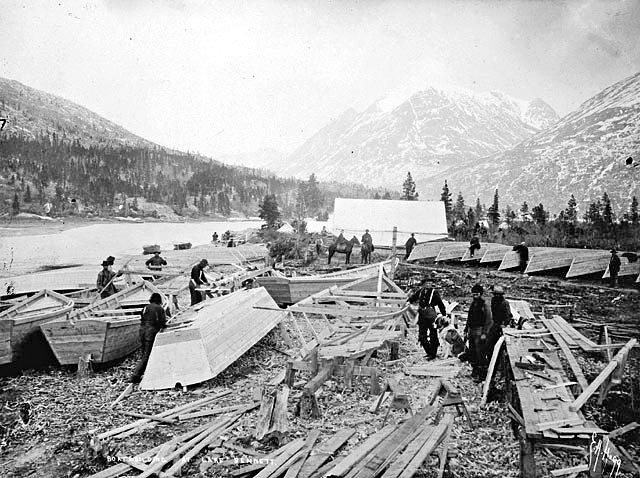
Lake

Lake Bennett Boats

And provisions:  The miners were in a hurry; Hayes worked them a little.  Five dollars bought the boat, together with, “twenty pounds of flour, eleven pounds of bacon and two pounds of prunes.  A coffee pot, a frying pan, two tin plates, some knives, forks and spoons.  What more does a man want on the Yukon?”  Well, Feodor had his cosmetics bag and Hayes had a change of underwear and two blankets.

One of the blankets and a stick found on a gravel bar make a passable sail and the journey starts fast:  140 miles to Kokrines in “eighteen hours and twenty minutes, actual timing.”  Of course Feodor’s hands won’t let him row more than an hour even if he did know how, but Hayes teaches him to steer with an oar when wind fills the sail, so Hayes can get a little sleep.  “Feodor does not realize the seriousness of our position.”  Not yet anyway.

Between Bennett and Lindeman Alaska; not exactly the right place, but the right image

Ten miles below Nulato, 290 miles below Fort Gibbon, out “two days and ten hours,” the wind whipped around to the west (head on) and chopped the river rough as open sea.  Hayes and Feodor put in to a small native village trying to buy some fish.  Hayes, Feodor and the native men find they have only the word “hooch” in common.  “We had none, and they lost interest.”  But a woman from the village who had learned English at the native school at Holy Cross approached with two small children suffering from “the hordes of mosquitoes.”  Hayes gave her some carbolic salve and, when she asked if they had anything to read, could only offer some Salvation Army tracts a man gave him at Fairbanks.  Attention to the children bought them a load of fish, “that we accepted with thanks, but threw over the side when we turned the first bend.”  Cultural differences on how long fish remains edible.

Hayes describes the mosquitoes as truly ferocious.  Here is the once daily drill with the flour and bacon:  “I take the oars and drive for a (sand) bar at full speed.  Feodor stands in the bow, and when the boat strikes the sand, he leaps out, runs to the drift with a bundle of birch bark in his hands and has a fire going by the time I have moored the boat and got the grub box ashore.  We light several fires as quickly as possible, fighting mosquitoes the while.  Then I fry bacon and flapjacks and make a spot of coffee, which we eat while sitting in the smoke.  Then, after cooking enough for the rest of the day we get more bark for the next stop, take the grub box and run for it again.”  Out in the middle of the mile wide river, the mosquitos aren’t so bad, “and when the wind blows we escape them.”

The sun sets for a couple of hours each night but never to darkness.  Feodor is afraid of the Northern Lights; Hayes is afraid of the empty native villages they pass one after another.  He writes, “hooch peddlers float down the Yukon each spring behind the ice.  Then they can sweep up the furs in every Indian village and encampment…  The bootlegger has done his work well.  Selling all their furs to buy booze, there was nothing left for flour and other provisions, so they starved when winter came.”

Above Kaltag, Hayes and Feodor pull ashore at another village escaping the rain.  A native family takes them into a fine cabin (abandoned by woodcutters) but won’t sell them salmon for money.  Furthermore, “something about our appearance aroused their mirth, for without any movement on our part the three boys of the family would laugh loud and long.”  In this instance, a stitch kit was more valuable than money.  Hayes fixed a pair of shoes for a young woman then gave her the tools.  She reciprocated with a well-cooked salmon dinner.

Below Anvik, they meet a priest, “a humble man, living with the Indians as one of them” who could interpret for one of the elders:  “When the Russians were here, they brought us good clothing and other goods, but the price was very high.  Now the Americans bring us poor material, and the price is still high.  The Russians brought no hoochino, but the Americans have ruined our people with it.   During the Russian occupation we were many.  There were four people then to where there is one now.  In a few years we will all be gone.” (Hayes’ quote.)

Now that Feodor’s hands are hardened to rowing, Hayes thinks about making a smudge to keep the mosquitoes off – Maybe a little later, Feodor rows better when he has to move to keep the bugs off.

July 15, eight days on the river and precious little flour and bacon remain in the grub box.  Hayes hears a beckoning from shore and pulls in to find a grey-haired prospector who leads him to a tent where his once gigantic friend lies withered and broken.  “During the previous winter he had been frozen, his feet are now black and gangrened.”  Hayes’ admiration for these hardy men merits exclamation marks:  “But with splendid spirit his partner has cut wood and is trying to sell this [to passing steamships] to pay their passage to the states.  No seeking relief for these self-reliant men!  They are trying against almost hopeless odds to pay their way as they go.”  Despite Feodor’s protests, Hayes leaves half the flour and bacon with the two prospectors.  “It is the right of any prospector to ask for food, for he may be asked himself under the same circumstances.”  Hayes also left the last of the Salvation Army literature with no recorded complaint from Feodor.

Hayes and Feodor left the two prospectors shorter on food but longer on information.  “We were soon in the maze of the delta channels after passing Andreafski, which is 180 miles above St Michaels (sic).  It was fortunate we met the two old miners, else we would never have know which way to go.”  Following the miners’ directions they came to a group of Eskimo men fishing.   One wanted passage north to an Eskimo camp at the Pastolik River mouth for which he eventually paid “a splendid king salmon.”  Perhaps more importantly, the local man showed Hayes a path to the end of the Yukon on the Norton Sound.

The Eskimo men let Hayes and Feodor rest in their shaman house, sold them half cured salmon they’d put up for the dogs and offered them a kind of mulligan stew made from all but the tail and wing feathers of some wild fowl boiled in seal blubber.  “Neither of us could force it down.”  The locals had better food but apparently Hayes had a gold-filled tooth that lead them to believe the two travelers could pay more handsomely than they would.

After more than 800 miles down the Yukon, only forty miles separate the mouth of the Pastolik from St. Michael – forty miles of open sea.  “It has been the worst passage I have ever made.”  A lull had come to the previous day’s storm but the wind freshened immediately after their small boat crossed the “rough bar.”  Hayes hoisted their blanket sail while Feodor lay helplessly seasick moaning in the bottom of the boat.  “The wind blew stronger as we kept on.  Billows broke about us, over us, and for a time I managed to get the now desperate Feodor back to man the steering oar while I bailed for life.”  After 13 hours at the oars, the blanket sail, and the bailing bucket Hayes spied a tall pole “some kindly hand” has placed showing where to tuck safely in behind Egg Island.  Safe from the storm but completely lost:  “Channels, one after another, lead off here and there, and we wonder whither we are going.”

Fortunately the two lost adventurers stumbled across one more kind stranger who knew the river.  In return for the last sweepings from their flour can, the head of a native family gathering berries drew Hayes “an accurate map of our route, placing all the false channels and drawing a line across each.”

After one more short stretch rowing on open sea, Hayes drove hard onto the sand at St. Michael where, “Feodor leaped ashore and without a word cleared up town.”  Hayes sold the boat (“I had gotten a real affection for our boat, a clumsy craft on whose bow someone had inscribed ‘Mary Ann of White Horse’”) for two dollars, gave away their gear, then went looking for Feodor, former half-owner of the Mary Ann, “and gave him his buck.”


2.3 Dawson to Fort Gibbon

March 11, 2012

I’ve included two maps this week.  The first shows this episode with Hayes traveling down the Yukon river into the very center of Alaska where he finds a brief bit of work.  The second shows his path in the previous 18 months.

June 17, 1908 – July 5, 1908

Hayes seems to have been on a sightseeing trip rather than seriously seeking work up the Yukon.  Still, he’s got to find a paycheck somewhere; the price of food alone has flattened his purse.  A moose steak dinner costs a dollar and the least meal is fifty cents, “and I have eaten no higher.”

With Dawson “rapidly fading into a ghost city” of no more than 3,000 people where 35,000 bustled ten years ago, Hayes decides to press upriver to Fairbanks, “despite the rumors I hear it’s futile.”


Dawson City 1908

At Fort Yukon, the river winds briefly north across the arctic circle so, “It is midnight, yet the sun is shining.  It is low on the horizon, and for fifteen days does not go below the horizon.”  Their stern-wheel steamer Sarah, “one of three great river boats, the Susie, Sarah, and Hannah,” makes slow progress in this sixty-mile wide swampy portion of the Yukon River where a boat could easily be lost.


Stern-wheel steamer Sarah

“Somehow one feels depressed and gloomy by the magnitude of the river.  It sweeps silently and forever onward, as relentlessly as the progress of the sun.”

Bending south below the Arctic Circle, the Sarah arrives at Rampart:  “Just another Yukon town.  A mile long, one street wide, many dogs, a few women, many ragged men who show the signs of hardship and the toil of futile seeking after gold.”  Hayes estimates that not one man in 500 will leave Alaska with more money than he took in.  “So it will be with me doubtless, but the experience no one can rob me of.”

At “Tanana, or Weare, or Fort Gibbon, take your choice and call it what you like,” Hayes describes the river as “lacustrine.”  Somewhere along his rough and tumble life he learned some big words.  Tanana is the end of the line for the Sarah; she’s too large to navigate up the smaller Tanana River, tributary to the Yukon.

By 1908, Fairbanks had replaced Tanana as center of trade for this region.  The mining at Fairbanks remained active but deep: “From fifty to 160 feet overburden, then the pay streak in gravel three or four feet in depth.”  Even in summer the ground never thaws more that three or four feet deep so the miners force steam pipes through the “frozen muck” to reach the gravel pay streak. “It is said that at Fairbanks one mine put a shaft down 600 feet and did not get through the ice.”

Pay is $2.25 for a ten-hour day running crouched over a wheelbarrow of steam-thawed gravel in a low ice-tunnel more than fifty feet underground.   About 3,000 men work the mines with 2,000 idling about town and more arriving on every boat from the south.  The mining company placed the “flattering advertisements” Hayes saw in Seattle to achieve precisely this end:  lots of unemployed men each keeping a man with a job working at top speed.  Passage back to Seattle from Fairbanks, overland in winter or by river in summer, costs $125.  Hayes doesn’t say how much he has in pocket but it’s not $125.

June 28:  “No job, no chance of a job.”  Except… “There is a river steamer here, the Relief, and I have asked the mate for a chance.”  The mate replied, “Nuthin’ doin!”  (Hayes’ quote.)

Pulpit rock
Stern-wheel steamer Relief

Still, “inside advice” says the Relief is short a man.  Hayes is determined that man will be him.  In the meantime, he observes the locals: “pimps, gamblers, prostitutes, musicians about the dance halls, prize fighters, politicians and other shady characters,” all living off the toil of the 3,000 men behind the wheelbarrows.

July 1:  Hayes got the job on the Relief steaming back down the Tanana River to Fort Gibbon/Tanana/Weare.  His protestation, “Look here, I’m a sailor!” (Hayes’ quote) finally elicited from the mate, “All right, I’ll try yuh out.  If you’re no good, I’ll fire yuh at Gibbon.”  Competence as a sailor won’t be the issue; cases of whiskey almost entirely fill the cargo hold of the Relief – Hayes will be expected to unload it all at Gibbon.

The mate’s surprised reply when Hayes explained his unwillingness to handle alcohol?  “Why I’m a Christian, and I handle booze.”  At Gibbon, Hayes wrestled all the general cargo from the hold, refused to lift the whiskey, locked eyes with the mate, gathered his belongings and walked ashore with no word exchanged.  Half a dozen men jumped for his place, the mate chose one, and the Relief steamed out of sight round a bend in the river leaving Hayes high and dry 900 miles up the Yukon.


2.2 Holtville to Dawson

March 4, 2012

Once Hayes got his health back working in the American west, the old wanderlust grabbed him again.  Though he knows the Alaska gold rush is played out, in the spring of 1908 he decided to go up and see the country for himself.  By June he’s at Dawson halfway down the Yukon river in the heart of Alaska.

Once again, the length of the map of his travels in eight months is remarkable.  Click on the title of the post to go to the site.

October 16,1907 – June 14,1908

Today, flat rectangular fields checker the Imperial Valley where the Colorado River feeds some of the most productive agriculture land in the world.  Every drop of the river finds its way to one of the squares on the board; none reaches the sea.


Imperial Valley, California

In 1907, the Imperial Valley rose and fell in hummocks cut willy-nilly by flash floods seeking the Pacific Ocean.  Hayes and his mule team driven four abreast had a small hand in leveling this vast desert filled by “sands gouged out of the Grand Canyon.”

Print of section of photograph, Imperial Valley, 1901 - NARA - 296427
Imperial Valley, California 1901

But not much – he drove the team for a month and 10 days.  Drinking water from the newly formed Salton Sea caused a kind of dysentery and the pay was low.  The company offered $50 for seven days a week but reduced Hayes to $45 when he refused to work Sundays.  The dysentery combined with lingering malaria pushed him back to Los Angeles:  “I am more desirous of health than a job just now.

Back outside Los Angeles, Hayes now sees “plenty to do here if a man is not particular what he does.”  He quickly found work – driving four mules again, “this time two span instead of four abreast” – hauling clay in a brickyard with a Mexican crew.  This job lasted two weeks.  Simons, the boss, cut the pay without notice.  All the men held on until payday then promptly quit. Hayes caught a smile from the pay clerk when cashing out but only understood the clerk’s dark scowls directed to the other men after learning that two of Simons’ barns had burned the previous night.

Over in San Pedro, he found a couple weeks’ work at the Salt Lake Railway docks in San Pedro under a brute of a boss and the sting of fair weather friends mocking his penury.  “It is a temporary job at best, and where oh where will I go?”

To Eureka of course ­– to ask George Glenn for his old job back at the mill.  When Glen asked, “Will you promise to stay on?” (Hayes’ quote)  Hayes couldn’t lie to him, so he went on north to Little River where 300 giant Canadians were cutting trees, laying rails, and building a new sawmill in the constant rain.  At least the food is good.

But his heart isn’t in the work and a thirtieth birthday sinks his spirits even lower.  “A man is supposed to have done something toward finding his place in life at that age, yet I am still a drifter, and likely always will be.”  Still, when he spies Mike Mulcahy, a friend from his brief stint at business college, now far out-ranking him at this Canadian company, he writes, “I wouldn’t care to be Mulcahy just the same.  None of the men like him, he is a “company” man.  That is, the company is always right, no matter what happens.”  Hayes is a man who knows what he wants, respects himself as a principled working-man, and accepts the consequences of sticking to his own standards – even if he gets a little blue on his birthday.

In March of 1908 Hayes writes eloquently of what he admires perhaps most in life:  hard work, done well.  “The snatch teams that haul timber from the small mill to us flounder deep in the mire, but such skilled men are handling them they are never stuck.  This timber business is a marvelous thing.  Each man must know his work, he is a skilled man, yet is counted a laborer.”  Of course, he goes on about how the company fails to recognize these skills and his skills in particular, but Hayes can see the beauty of work well done even if the bosses cannot.

Nevertheless, Hayes lasted only from December 1907 to April 1908 at the lumber camp.  The lumberjacks had a good medical facility, but the mill owners set up a company hospital intending to force their workers to subscribe to substandard care at $1.50 a month.  All the men vowed to strike, but when the edict arrived only Hayes and Mike Mulcahy’s brother refused.  Two striking men are the same as two men quitting.  Hayes thinks maybe he’ll go north.

The Klondike gold rush began in 1897 and was essentially over in 1899.  In those two years, thousands of soft-handed city men poured into the Yukon feverish to sluice out an easy fortune.

Miners climb Chilkoot
Chilkoot Pass September 1898

Ten years later, when Hayes went north, a few large companies had already bought up any promising strike.  At Seattle in 1908, Hayes reads,  “many adds telling of the wonderful opportunities of employment at Fairbanks, and there are others posted by the miners union saying the place is already crowded out with men and no jobs for them.”   Still, Seattle is dull, mill work is “everlasting,” and “the call is on me and I am persuaded to go.”   Characteristically, boredom with the familiar and curiosity about the edge of the wild drew Hayes open-eyed to one of the most amazing feats of his life – his exit from Alaska to be described in the segment 2.4 of this synopsis of his diary.

At Skagway, miners returning to softer climes after years “inside” the Yukon basin tell Hayes stories of hardship, poverty, even death.  For about a minute, he thinks about selling the remainder of his ticket and returning south – In another week, he’s working the dock for the White Pass and Yukon Railway, saving for supplies to get “inside,” and telling tales of Soapy Smith’s death and burial outside the town limits.

May 22, Hayes writes that he has a “girl friend” in Skagway who “urges me to work for her dad, who has a place of business in town.”  (That’s ‘girl friend’ not ‘girlfriend.’)  Her proposition gets about a minute’s consideration too; his ticket shows he’s shipped his baggage on the train to White Horse – in fact, Hayes, travelling light as always, shipped baggage for an overloaded greenhorn under his name, a detail omitted from the girl friend – sadly he must follow at least that far north to claim his possessions.


Steel Cantilever Bridge on the White Pass and Yukon Route

The magnificent railway from Skagway to White Horse (still operating as a tourist attraction today) draws only passing mention from Hayes.  He’s more interested in the “men of a low type” playing exquisite baseball at White Horse while waiting to go “inside” to positions at the Yukon Gold Company “which belongs to the Guggenheim interests.”  The company pays fare for the men from Vancouver plus $2.25 a day while at work, and, if they last four months, passage back to Vancouver.  Quit early and pay your own way back – if you can.

When the ice finally breaks, the run to Fort Selkirk is uneventful:  stuck a few hours at a shallow in Lake Lebarge, some fast water slapping the steamer around, tales of “toughs who will not work” robbing prospectors then slipping their corpses into blow holes in the frozen Yukon – the usual for Hayes.

At Dawson, the picks and shovels of the earliest days of the gold rushhave given way to the enormous dredges of the Yukon Gold Company.

Klondike mining, c.1899
Klondike Mining 1899
Dredge and thawing system
Dredge and Thawing System 1908

Hayes immediately spots the Guggenheim’s swindle:  men with four-month contracts are fired at three and a half months so the thrifty company saves return fare on men not fulfilling their contracts.  The Canadian Mounted Police seem to be trying to do something about the company racket but their hands are full with more important matters:  Ned Elfors, one of murderous“toughs” Hayes mentioned, only creased the cheek of Anderson, a companion and would-be victim.  Apparently Elfors had been more accurate with a second companion named Bergman.  Anderson’s story, together with a doctor’s testimony that all the bullets removed from Bergman’s body came from Elfors’ gun, condemned Elfors to hang.

Six weeks in the washed-out Alaskan gold rush already has Hayes writing:  “I find nothing in Dawson to keep me here.”


2.1 September 7, 1907 – October 16,1907

February 26, 2012

Hi all, Volume II is every bit as adventurous as Volume I:  the Yukon gold rush, Australia and New Guinea, and back to Africa.  I’ve streamlined the text a little bit.  I’m still trying to convince the reluctant of the inestimable value of the maps.  The currently sparse Google Earth version will soon show Hayes’ first circumnavigation of the globe.  At least click to the site to see the flat map.

You will recall that in September of 1907 Hayes has just departed Africa, sick, disillusioned, and broken-hearted.

Download Volume II in google earth.

September 7, 1907 – October 16,1907

In August of 1907, forced from Africa by Malaria, outrage at colonial injustice, and his steadfast refusal to trade in liquor, Hayes fled north to Liverpool. He had planned no destination beyond that “dirty, windy city” – only a retreat to heal the wounds suffered in Africa.

If Hayes can be said to have a home in 1907, or at least a center from which his adventures radiated, it would be the Southern California coast. With little volition of his own, San Francisco drew Hayes back, Los Angeles restored his health, and a small town near the Mexican border offered him farming work.

From Liverpool he sailed third class in the “Asiatic steerage” on The Empress of Britain across wild seas bringing his ever-attendant mal de mer. Once across the Atlantic, in the relative calm in the Gulf of St. Lawrence, Hayes and some fellows had recovered their sea legs enough for a small prank:  before every meal, the immigrant passengers jammed down a small passageway leading to the ship’s one dining saloon. “Yesterday a half dozen of us slipped down in the first lot and waited for the crush. When the doors opened, we seized hold of the handrails on either side of the alleyway leading to the saloon and watched them pile up. We won’t do it again, for my ribs are stoved in and very sore.”

SS Empress of Britain in 1905
SS Empress of Britain 1905

Feeling “old and beaten,” with “no heart to face the crowd in the United States, who will say I am a failure,” Hayes dawdles a day in Quebec to allow the shipboard immigrants a day’s head start toward Montreal. He knows the immigrant train has cold, hard, steel seats. If that train gets away, with luck the next “might have velvet cushions to ride on to Vancouver.” But Quebec was not a lucky city in September of 1907; the center span of a massive bridge construction had collapsed just before Hayes arrived.

Quebec Bridge Collapse of 1907

Even after touring the wreckage for a day, Hayes had no luck avoiding the immigrants either.  He joined them on the steel seats at Montreal for the long ride across what he describes as “desolation all the way from Ottawa to Winnipeg.” The scenery improved in Western Canada, but after seven day’s rail journey across the continent, Hayes arrived to a Vancouver convulsed by race riot: “I find myself in the midst of a riot that approaches war. The workers of Vancouver are raging tonight, tearing down store fronts of Chinese and Japanese business houses, tossing belligerent Japs in the bay, beating up Chinese and breaking all the windows in the Asiatic quarter.”

Damage done by the Asiatic Exclusion League
Vancouver, Canada 1907

After the rioting settled, Hayes left Vancouver, a city still “ominous of trouble” sailing on the Puebla, “an old time wooden vessel plying this coastal run” to San Francisco. In the year since the great fire, San Francisco already rises from the ashes – emphatically unionized! “And woe be to the reckless fool who does not join a union on arrival… he will wake up in a hospital, or in a back street so badly beaten he will never be right again.”

Not a union man, and not liking hospitals, Hayes continued on to Los Angeles on the Hanalei, “an antiquated steam schooner that carries a few passengers on the side.” Down to $170 on arrival, he needed:  first, the return of his health; second, a job; and third, no company of any old friend. A week in Los Angeles provided the return to health, but “is the last place in the world to look for [a job] these days.” Feeling strong again, Hayes beat it out to Holtville in the Sonoran Desert and a job driving four mules clearing land for cultivation.

In six months he’ll be in the Yukon Territory, Alaska.


37. Forcados to Liverpool

October 16, 2011

Hayes ends the first volume of his Diary Here and There fleeing Africa sick with Malaria, broken in spirit, nearly penniless, back to immigrant infested Liverpool.  Yet the final line of the first volume is wryly upbeat.

Having come to the end of the first volume, I’m going to take a short break from publishing this synopsis of Here and There.  I’ll resume with volume II in a few months.  Thank you for reading along. We’ll be back.

On the map below, you can see Hayes leaving Africa, returning to Liverpool on a long red path.  Click the title if the map doesn’t show in an email.

Click here to download chapters all 37 chapters of Volume I on Google Earth.  

Here and There Synopsis:

37.1 A Fevered Departure.

August 8,1907

The freighter Zaria stops at every small port along the African Coast; now at Salt Pond (sic) where naked children play in the surf beating on white sands while their father’s row to and from the ships anchored off shore ceaselessly chanting. To Hayes, “It is beautiful beyond compare.”

Feverish with malaria Hayes writes, “My head aches constantly, but it does not equal that of my heart. The disappointment, the sense of failure that is so overwhelming beats me down.” Sorting back through his experiences he writes, “I can’t see a loophole whereby I might have succeeded. The missionaries all wink at the booze trade, are even supported by it in a left handed sort of way, they too are equally guilty of the debauchery of the African people.” How can he return from his grand adventure after only a few months? “What to do, what to do. If I return, I will be counted as a failure.”

All the memories stew Hayes’ fevered foul mood: “I can see the villages now clearer than when I have been in them during the past seven months. The women, who do most of the work, tending their tiny babies…. The babies, painted a vivid red with the sap of the root of a certain tree…. The men guzzling gin, drunken, bleary eyed, often fighting. The younger women also drunken…. Children hanging onto the fringe of the crowd in an effort to get at least a swig.” Hayes wonders openly if Africa benefits from its occupation by the Europeans: “The latter has stopped the slave trade and human sacrifice, but he has saddled this debauchery on them, and it is worse.”

37.2 Sekondi

August 10,1907

Sailing westward, Hayes submerges his sense of personal defeat into descriptions of the surrounding terrain and events aboard ship. Characteristically, he likes to know where roads lead: At Sekondi, “A railway runs from here up to Jumasi, (Kumasi) capital of Ashatni”. Only recently conquered, the Ashanti continue to resist the British, but this is a land of gold, so the Europeans persist.

Aboard ship, a Kroo sailor stole a bolt of cloth. “The skipper of the Zaria is a hard boiled seaman. Scotch, he has no nerves, no conscience, no heart. In the place of this latter organ he carries a wet sock that fully answers for such purposes as he lives for.” After a search turned up the cloth, the skipper garnished the man’s wages – a shilling a day. “It all goes into the thrifty captain’s pocket, all but the cloth itself, and he has that back.”

37.3 All Coast Ports are Alike

August 16, 1907

Axim, Half Assinie, Assinie, Grand Bassam, Grand Lahou… “All the coast ports are like each other. No harbor, just the long line of sand that fronts on the sea for a thousand miles, perhaps a lagoon behind and forested hills rising beyond that.”

West African Coast

Cargo and passengers land in open boats tossed by the surf. Mahogany logs are floated out, hoisted up, and dumped into the hold. “A dangerous business but what’s a man now and then?” Hayes’ foul mood persists: “We have lost but one thus far. A Kroo, whose foot was cut off by a sliding log.” The log nearly severed the man’s foot at the instep – the amputation was completed by a drunken European doctor with a pair of scissors.” The Kroo man “has lockjaw now, and is writhing in agony.”

Along with some palm oil, palm nuts, cocoa and copal –

Palm Nuts

Copal Beads

– the Zaria’s crew loads a French officer barely alive with Blackwater Fever. The stewards look on him with disfavor knowing that dead men don’t tip. “If this man lives to France he will do better than I believe.” But Hayes’ confidence in European colonial rule has returned: “When Europeans solve the health question that confronts [the Gold Coast, the Ivory Coast, and the Slave Coast] then this land will fill with people even as India has under British Rule.”

37.4 White Man’s Grave

August 21, 1907

“The Frenchman died off the Liberian coast, where we tarried for a day or two, doing a little private bootlegging among the natives.” The skipper and purser have a private stock of gin and rum aboard for the many canoes that crowd about the Zaria at every small village. “Sometimes there would be 75 canoes round our ship.” Only a few are permitted aboard at any one time, but after the jockeying for position many canoes left “laden deep with booze.”

Shortly before the Frenchman died, the chief steward grumbled to Hayes, “What bloody good is he to a ship? We have to wyte on the blighter without a chawnce of gittin’ a blommin’ penny, an’ hit’ll be that ye till we git to Sierra Leone.” (Hayes’ quote.) But when the man did die, it silenced the “grasping, insatiate stewards for the moment, for death is never far distant on the West Coast.” Before the skipper could bury the man at sea, some French comrades intervened asking to take the body to Freetown for burial. “He was wrapped in a blanket, tossed into the six inches of water in the bottom of a surf boat and taken shoreward. Life doesn’t mean much after all.”

37.5 Tenerife

August 27, 1907

The Zaria passed Dakar without stopping but called at many other small ports including Konakry before coming on to Santa Cruz De Tenerife. If water can be found on these islands… Tenerife, Las Palmas, Grand Canary… they are unusually fertile growing marvelous oranges and bananas. Some shipmates went ashore to Oratava (sic), but Hayes is both broke and sick with malaria. “The fever never leaves me. I must have a touch of the sun.”

37.6 Madeira

August 30, 1907

“Madiera. This is the finest Island we have seen yet.” The forest remains beautiful despite what Hayes sees as the wasteful, destructive ways of the Portugese. “We are lying in the roadstead at Funchal, so have an excellent view of the island as it lies before us.”

Madeira Island

Funchal Madeira pre-1907

The beauty of the island merits one paragraph; the moral condition of its inhabitants gets three. Thievery, drunkenness, prostitution – Hayes’ typical complaints – overlain with a sharp critique for the Catholic church: “Yet all these people are active Christians.… Wherever one goes here or elsewhere in lands controlled by Portuguese or Spanards he sees priests, nuns, friars, and such, all of whom are supposed to be celibates, too holy to indulge in sex relations with the opposite sex, man or woman. Why is it their laity are so rotten?”

37.7 Liverpool

September 4, 1907

Liverpool isn’t nearly as pretty as Madeira but it’s better for Hayes’ health. Mingling with the filthy crew of the Zaria, “infected me with craw-craw, one of the worst skin diseases West Africa can bestow on the white man.” But in the damp chill sailing up the channel Hayes’ skin already begins to clear and perhaps the malaria as well.

Immigrants from all over Europe, “most of these are the off scourings of Eastern Europe,” crowd Liverpool headed for “the big steel mills and coal mines surrounding Pittsburgh, or else sent to the far northwest of Canada to work on the Grand Trunk Railway building to the Coast.”

Hayes needs a ship to escape this crush of vermin infested humanity. “Lying in the stream is the great new Lusitania, the finest ship I have ever seen. Or any one else as to that, for she is the new queen of the seas just returned from her trial trip.”

Lusitania

How nice to travel on such a pretty new ship, but they laughed at the Cunard office when Hayes inquired about passage. “As she is expected to beat all records across the Atlantic, even millionaires are going steerage on her.”

He didn’t get to board the Lusitania, nevertheless the first volume of Hayes Perkins’ Diary Here and There ends with an upbeat sentence. Hayes stopped by the Miller Brothers’ offices seeking payment. “Cowan was there, and was courteous and kindly. He gave me ten pounds extra, saying the company should share in my expenses to and from the Coast. It does renew one’s faith in human nature to meet an honest man now and then.”


36. Sapoba to Forcados Mouth

October 9, 2011

When I first read Hayes’ diaries in the 1970s this section stuck vividly in my imagination too.  Such bravery – or foolishness – in the name of adventure.

Google maps is back again.  If you are not seeing a map below click the title it will take you to the blog page.  On the map, the previous chapter, 35, shows in pink; the current, 36, shows in yellow; and, 37, the last chapter from volume one of Hayes’ five volume diary shows him leaving Africa broken hearted with a red path.

Click here to download chapters 1-36 on Google Earth.  

Here and There Synopsis:
36.1 Sapoba

March 10,1907

Pajah and the “renegade mission convert” named Comay run the palace at the village of Sapoba where Hayes temporarily quarters. “They are two devils, though perhaps no worse than my own countrymen would be under the same circumstances. Both are brutal, avaricious, lustful to the nth degree.” Comay retains the semblance of Christian worship but also serves as “one of the heads of the Ju-Ju worship, which is in full blast all the time.”

A lengthy passage from Hayes’ diary explains how Comay might reconcile both his religious practices: “Like all Africans I have seen, they apparently have one great-father-god who is the creator of the earth, the universe and all therein. He is well intentioned toward mankind, so there is no need to seek his favor that is unchangeable. It is the thousand and one malign spirits that dwell in trees, in stones, in water, in wild animals, and insects even that must be propitiated.”

A spirit named Gulu worries Pajah and Comay just now. Gulu resides in the river and Hayes can hear him. “It is a trifle uncanny to hear a deep gurgle coming from the depths at any time saying ‘Gulu-gulu-gulu’ for perhaps five minutes on end. A scientist would say it was the gases imprisoned at the bottom of the deep river, but we who live at the village of Sapoba know better.”

If he’s going to cut mahogany, Hayes has to have tools. So he and Comay travel in a canoe paddled by Pajah’s slaves to an old bush camp where a previous timber agent had abandoned some gear that might be salvaged. When Comay lashed the back of a small boy sitting beside Hayes, “I seized the whip and flung it over the side. This brought on a row between Comay and me, while the luckless slave writhed in pain and terror.” Of course Hayes’ impulsive gesture had consequences he could not control:
“I am sorry I intervened now. This morning I saw the slave, his face beaten into a pulp, in a semi-unconscious state.”

Deep in the bush away from Comay, and whips, and slaves, Hayes marks trees “and Pajah weeps because I do not choose more for cutting.” While the old king tries to “inveigle me into an affair with some of his wives,” Hayes escapes into the fascinations of the surrounding forest.

Driver Ants

Driver Ant

Hayes says the driver ants are always on the move busy going nowhere. “When they cross a glade where the sun shines at noon, the carriers seem unable to bear the full rays of the sun. Then the soldiers join their mandibles until they form a living tunnel under which the rank and file of the army passes into shade on the farther side.” No living thing gets in their way: “From the cricket to the elephant every beast respects the driver ant.”

March 22, 1907

In order to appease Gulu, Pajah calls his subjects, his wives and his children nightly to a small shed to worship “two small mud images who are special objects of his devotion.” As the wives kneel in prayer, the children and courtiers dance to the beat of “many drummers who fairly raise the treetops with their clamor; and there are sacrifices, not human, but dogs and goats and many fowls.” The women reach great heights of enthusiasm while “children with bullroarers help to make the night hideous.”

In addition to the mud images, Pajah holds sacred two great rats “almost as large as cats.” The entire court retinue reveres the rats – except Hayes. He killed them both with a deadfall to save his scant store of rice, ham and bacon. “So great was the strength of the last he almost escaped from beneath a box containing more than 100 pounds of goods.” Hayes jumped on the box to finish the job, then threw the evidence of his irreverence to the razorbacks milling beneath the house.

None the wiser abut the fate of his rats, Pajah says he’s building Hayes a house across the river but dawdles on the construction while making sure a wife who speaks a little pidgin remains near the “ibo” (the local name for white men as quoted by Hayes) should the ibo become lonely at night – “but she is out.” The list of fetishes under the head of Hayes’ bed intended to deliver him into Pajah’s power includes: “Gourds containing vile smelling grease, bundles of hair, crocodile teeth, leopard’s claws, and many other charms.”

He writes “It’s a great life if I can stick it. Wish I was across the river.”

April 20, 1907

Back on March 10th Hayes mentioned an agent named Richardson who runs a camp a few miles upstream for a rival company. Herald, Hayes’ boss for Millers, had warned Hayes off Richardson but Hayes, ever his own man, struck up something of a acquaintance with the competing agent whose thievery eventually granted Hayes’ wish to get across the river.

Writing in his diary in April, Hayes describes a precious stone set in fancy beadwork owned by Pajah as, “a gem of purest water, a beautiful object of real value resembling a sapphire.” Hayes’ offer to buy the stone from Pajah elicited, “Wot! Man sell him head!” (Hayes’ quote.) So Richardson showed up while Pajah was away, learned of the existence of the gemstone (presumably from Hayes), stole it, smashed the two mud idols, “and bombarded Pajah’s many screaming wives” with sacred shards. Richardson left with the stone but “dashed me a fine pair of shoes in recompense for the shirts” that had gone missing when Pajah’s wives ransacked Hayes’ belongings looking for the stone.

Hayes’ description of the ensuing scene begins with a laconic, “So things are not so hot.” All logging operations ceased for eight days of Ju-Ju worship. “I am compelled whether I like it or not to be present at the ceremonies, as wild as may be seen on earth.” The “resurrected gods” must be cleansed with the blood of goats, dogs, fowls, and razorbacks in numbers “beyond computation.” Day and night, “All are wrought into a fervor that makes them dangerous. The naked Jekris, topped by fearsome headdresses with bundles of rattles tied round each knee, drive at me with spears, barely grazing my shoulder. I never move, it would be useless.” Sleep? “With fifty drums constantly throbbing, with countless bull roarers screaming, and with yelling natives rushing from one end of the island to another, tearing through walls in search of the offending spirits now loose on the island sleep has been unknown.” Food? “I am starved for Pajah has me helpless.” When Hayes walks away into the bush, Pajah has him returned to the village, “escorted by his big sons,” (ever fair) “one of whom is a decent chap.”

The denouement of this fearsome eight-day ordeal is so unexpectedly foolhardy – or brave – or irreverent – one barely knows how to comprehend its author: “When I appealed to Pajah to cease the row and let my aching head rest just a bit, he gathered the entire village under my window.” Finally at his breaking point, as the whole racket and chaotic threat focused beneath his window, “I tossed a kerosene tin full of water over him.”

One wonders how this man ever lived to 86 years. Withholding the spears, Pajah had Hayes escorted off the island to the nearly completed house across the river. “At last I’m clear of this racket, though the workmen are noisy enough.”

Before the row broke out concerning the gemstone and the broken idols, a few logs had been cut. Despite the inefficient logging methods – “on one log recently I had 120 men hitched for more than two days, dragging it to water” – Hayes had assembled a raft of 100 logs. Now seems like a good time to float them down to Sapele, let Pajah cool down, deliver a few letters, and “try to get rid of my first case of malaria.”

36.2 Logs to Sapele

May 2, 1907

At Miller’s station in Sapele, every agent including Herald, the boss, “Seems to think I am doing well enough despite the difficulties with Pajah and his prime minister. For none of these men know anything about the bush….”

Perhaps three months isolated upriver actually cutting logs with a crew qualifies Hayes to assess other’s knowledge of the bush. At any rate, the agents “are delighted to find all the timber measured, checked and ready to ship without further worry on their part.” Herald continues to warn Hayes to stay clear of Richardson, not because he might be a thief but because other companies’ agents “are rivals in business and will defraud each other in any way they may just so long as they keep clear of jail.”

On the subject of jail, Hayes repeats his observation that local prisoners complain when released from jails established by the Europeans. He quotes two African men protesting to the commissioner: “Why are we being let go, Ibo? Have we not worked well, have given you no trouble; yet others whose conduct has been bad are kept on and we are turned out to starve in the bush?” Hayes summarizes the cultural misunderstanding this way: the Europeans are thinking of shame and punishment; the Africans are thinking of shelter and regular meals.

36.3 Back to Sapoba

May 23, 1907

Returning to Sapoba, Hayes finds a quieter village; Pajah “is in bad condition with syphilis.” Richardson has some Tabasco sauce to treat Pajah – one wonders how.

In the relative quiet, Hayes reflects on local colonial history. Three years before destroying Benin City and exiling Overami, the British had razed Brohomi, the central trading town of Nana Olomu an Itsekiri leader.

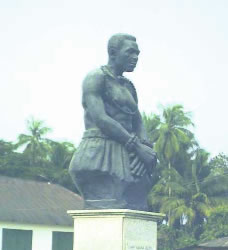
Nana Olomu monument

Inside a walled fort armed with “many guns, some of them swivel guns that could have come no way but through the medium of the Germans,” Nana fought until his forces “went down under the guns of the British.”

With Overami and Nana driven from power, “human sacrifice has been driven under cover.” Nevertheless, “it goes on just the same.” Hayes reports that British authorities recently uncovered a Ju-Ju house between Sapoba and Asaba “where the gods were being fed on human flesh.” More disturbingly, according to Hayes, some “Ju-Ju worshipers believe if they eat a bit of any white man, any superior person, the powers of that individual will enter them from that time on.” Hayes describes in graphic detail hearing about the slow death of a European doctor working in Africa killed in this ritual manner.

Whenever Hayes swims in the River at Sapoba, the whole village turns out to gawk at his skin color – especially the women. “A man has to watch his step in Africa, for these young girls are often beautiful and attractive as any European maid.” Hayes abstains of course but “most of the white men take natives as temporary wives.” Attitudes about this practice vary according to nationality: Brits ostracize their countrymen for living openly with an African woman; not ostracization for the Germans, but disgrace; for the French – c’est la vie.

36.4 Parrots at the Ogbesse River

June, 12, 1907

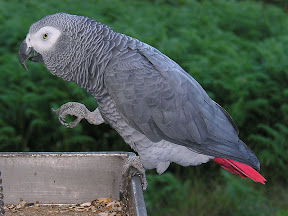
Hayes does not say whether he traveled overland or by river to scout the timber at a station on the Ogbesse River about 50 miles from Sapoba. The site had been worked previously, but some good timber remains. The timber is nice but, “What interested me most was a great parrot roost.”

African Grey Parrot
listed as “near threatened” on the 2007 IUCN red list

“From every quarter just before sundown these birds began to appear. They came in pairs, in flocks, every one of them shrilling his heart out. The noise was deafening, especially about the wide spreading trees where they perch for the night.” People native to the area tell Hayes that such communal roosts are common and that no parrot will rest elsewhere. So vast is the flock that great nighttime commotions follow the collapse of tree limbs under their combined weight. “These are the common African grey parrot, supposed to be the best talkers of all the species of parrots.” (The 2007 up-listing from species of “Least Concern” to “Near Threatened” by the International Union for Conservation of Nature results mostly from trapping for the international pet market.)

36.5 Rumblings of Discontent

June 12, 1907

By the last day of July, six weeks hence, Hayes will be sitting at Sapele waiting for a boat out of Africa. Today, on June 12th,he dismisses every reason one might expect to cause his departure. Pajah and Comay don’t force him out: “Ju-Ju ceremonies died a natural death at last, and old Pajah seems somnolent these days. Comay gives trouble, but I keep a jump ahead of him.” Nor does the constant physical threat: “I did get crowned with a club the other night while stopping a gang fight in camp. While dragging two apart another struck me over the head with a club, and for a moment I was staggered. On the whole I get on well enough with the natives, and if left alone could do well.” And the logging work is fine: “Have another raft of timber out and on the way to Sapele, so all is going fairly well.

No, after dreaming of Africa since childhood and finally arriving at age 28, Hayes leaves the continent after six short months because of the booze. “I refuse to have anything to do with gin and rum, so am out of things. Pajah, like all other chiefs, pays his men largely with this sort of trade whether the men like it or not. It is the custom of the country, and unless a man conforms to this he had as well get out.” Precisely what Hayes will do in about six weeks time.

36.6 A Boat at Sapele

July 2, 1907

The figure mentioned earlier – 67% of all imports to Africa are spirits – came to Hayes from Sir Walter Edgerton, governor of Southern Nigeria.

Sir Walter Egerton (far right)
Lagos 1910

Edgerton also said that the morals of the Africans would suffer unless traffic in liquor was in some measure curbed. “So vile is the squareface gin it is forbidden to sell it to an European. I have heard of only two white men drinking it, and these both died in a delirium shortly after. The same applies to the rum, which is a West Indian product.”

Hayes sees few American ships trading along the West African coast – case oil, and sometimes a little Jamaican rum – but much of the timber goes out to the US. “So crude are the processes of extracting this timber from the bush we cannot handle anything worth less than a shilling a board foot. Much of it is above this price, and Miller’s handled one fine figured tree that sold for 2,000 pounds.”

A lucrative business for Miller’s, paid for largely with intoxicants. Hayes won’t continue to participate.

July 24, 1907

Miller’s sent McPherson to replace Hayes at Sapoba. “With all the insouciance of youth he is telling me my mistakes. The only one I can see is I refused to cut timber smaller than the government regulations allows, and McPherson has promptly marked all these trees for cutting.” McPherson will, of course, have to bribe the forester to sign off on the small trees, but such practices make a good company man. “No one is honest, business means nothing else than robbery without going to jail.”

Richardson who came to Sapoba with McPherson diagnoses Hayes with “funkitis.”

July 30, 1907

At Sapele waiting for a boat out, Hayes talks with others in the timber business. “The fellows are kindly, and in a way understand. Many of them are not keen on this wholesale booze business, but none dare protest. If they do, they go home and don’t return.” One who will not be returning is Bowie, a beach clerk for Miller’s. “The doctor is sending him out, saying he will die unless he leaves at once.” Bowie and Hayes will depart on the freighter Zaria the next day.

36.7 Blackwater Fever in Warri

August 5, 1907

(I am hoping a reader more familiar with the waterways of the Niger Delta can suggest a more plausible route from Sapele to Warri. The two cities connect by river; I made one possible route.)

Four white men died at Warri during Hayes’ four-day layover there, three of them victims of blackwater fever. “It is the most deadly of all tropic diseases known. At least in Africa. The kidneys seem to dissolve, the urine turns to blood until its flow saps a man’s life. Thirty-six hours is about all a man will live when this disease attacks him.”

36.8 Off Burutu

August 5, 1907

A little farther downriver, anchored within sight of Burutu, Hayes knows he could go ashore to speak with Lenthall of Miller’s about the alcohol abuse. “What’s the use? He himself told me there was little else to do but to handle booze.”

36.9  Forcados Mouth of the Niger

August 5, 1907

So, instead Hayes must write: “Leaving the Niger. As I look back on the muddy flow of the great river (for this is the Forcados, the principal mouth) it seems the light will go out of my eyes. I have so longed for Africa, so hoped and desired to do something in this great continent that no other place appeals to me elsewhere.”


35. Osse River to Jameson River

October 2, 2011

Hayes’ account of the battle of Benin in 1897, ten years prior to his visit, is absolutely hair-raising (and I’ve edited much of the diary’s explicit detail for a general audience).  His version of the story credits the British with conquering Benin to halt the long-standing practice of ritual human sacrifice.

You can see from the map that Hayes’ first stay in Africa, though incredibly eventful, was brief.  The blue path shows his voyage along the coast; the pink is the current chapter; the yellow shows his path out of Africa after only seven months. Google Maps is misbehaving again here is the link to the map I describe.

Click here to download chapters 1-35 on Google Earth.  

Here and There Synopsis:


35.1 Up the Osse River

January 27, 1907

J. F. Herald, head of Millers Forestry Department, sent Hayes upriver by canoe to a lonely outpost in the bush “opened by a young Scot named McPherson.” The boatmen wanted to dawdle but Hayes kept them going along a fair flow of water continuously interrupted by sandbars and shallows. “Two crocodiles slipped off into the water as we passed, small ones perhaps five or six feet in length.” In this dry season of the year in Nigeria, the harmattan blows off the Sahara bringing cool nights and rain, “but not in deluges as it does during the long wet season.”

McPherson’s outpost sits in a small spot of light penetrating to a tiny clearing by the Osse River surrounded on all sides by dense forest. McPherson “is very seedy from fever and poor living alone in the bush. He is nervous in the extreme, and unless he gets out of Africa soon he will stay here in the White Man’s Grave.” Hayes takes up residence “in a bush hut thrown together by the listless natives,” with McPherson and “countless ants of several species, jiggers that bore under our toes and crickets that make the night hideous with their shrill noises.”

Outside the hut, “in this forest are not only large animals, but smaller ones that create a tremendous uproar, and above all this noise is the hum of countless insects whose combined voices unite in a tremendous roar in which no individual sound may be distinguished.” Among the insects attracted to their “feeble lamp at night,” Hayes remarks particularly on the rhinoceros beetle as “the most formidable,” and the praying mantis that can reach six inches in length and “have the most uncanny appearance for they can turn their heads on their hinged necks and stare one in the eyes unblinkingly.”

Rhinoceros Beetle

African Praying Mantis

Fishing with McPherson and some of the local residents, Hayes sees animal life in abundance: signs where buffalo have come to the river edge at night, elephant spoor, monkeys in the trees, antelope of several species, small predatory cats, and numerous bats and birds. In the little hut in the clearing, “the alarmingly shrill cry a small tree hyrax gives one the creeps the live long night.”

Tree Hyrax

In addition, “There are leopards but these do not harm the natives.”

February 10, 1907

Hayes’ 29th birthday; he marks it with the two words, “My birthday.” Herald has arrived at McPherson’s small outpost together with another man named Cowan, general manager on the coast. “None of these men have any idea of handling timber.”

Hayes’ writes with disdain of the wasteful techniques employed here: First a tree is marked, noting its distance from the river. “Then men with clumsy axes are turned loose on its trunk, and in two or three days it will crash the way it leans. Like a beaver going round a tree do these men cut all this marvelous mahogany, ruining much good wood and often breaking the tree in the fall.” Unbroken trees are then measured (by the European in charge) and marked for length. Then the men with axes go at it again, ruining several more feet cutting the logs to specification. Each log is “laboriously squared” and made ready for shipment by cutting a sloping front so it will ride the skids to the water. “Then this slope has to be cut off, when another three feet is lost.”

More disdain for the tools: “Crude axes, much too heavy, jack screws (if any) also heavy beyond words. Seldom a saw, and then useless because of no one knowing how to file it.”

Jack Scew

And finally, disdain for the labor practices: “The logs are hauled to the water with men. This requires at least a hundred men to drag a log of ordinary size to water. Rolling skids are used instead of ones set in the earth, and when possible whips are used on the men.” So much wrong with the business here! Use of the whip appears as only one in this long list; Hayes will however renounce its use over many years all across Africa – perhaps due to his own experience at the end of a whip. “I try to explain these things to Cowan and Herald, but they seem to be insulted at the counsel of a mere Yank.”

February 18, 1907

As if to underscore that Miller’s is a Scotch company, McPhail has arrived to replace McPherson at this lonely outpost up the Osse River. “A very supercilious young man, he is. Having been in charge of a beach at one of the factories for two years, he despises me as one of no account.”

In his month at McPherson’s station, Hayes has been helping and instructing the working men about more efficient logging techniques: to make a mattress to cushion falling trees, to use a saw (he sharpened the rip saws to a fair crosscut), and other ways of saving timber. “Furthermore, I treat them like human beings.” Newly arrived and insecure, McPhail, “naturally a bully, beats them to make them realize his importance.” McPhail’s methods are note well received: “Consequently we have a strike, the men dancing a war dance in front of our house now. McPhail is badly scared.” When the men regrouped after McPhail beat them off with a club, Hayes went out to the raucous crowd: “We wantum you. No want this other fella. He bad man, we no like um!” (Hayes quote.) Hayes explains his junior status in the company and tells the men of his impending transfer to another station. They all immediately swear they’ll leave with him. “This does not make McPhail any more courteous toward me. I’ll be glad to be away from him and alone.”

35.2 Benin City

March 2, 1907

“The past few days have been among the most interesting of my life. I first journeyed on foot to the famed City of Benin, thirty miles and more from the Osse River.” The way was straight and level for many miles, turning only once. At the turn, “There again we saw the Ju-Ju. I have seen several of these since reaching the bush, gigantic statues hewn from trees.”

Ju-Ju to protect crops

Around the statue, the road forked at right angles making a sharp V. “One may not cross the straight line, but must diverge and make obeisance to the Ju-Ju.” Hayes describes the statue he saw as: “A huge wooden god sat upright and obscenely naked between two female figures as bare as he. The central male figure must have been ten feet in height sitting, the females a little less.” Travelers along this way had left offerings of “cloth, bananas, fruit, fowls and thousands of cowrie shells.”

Money Cowries

Hayes explains that the shells are money left by travelers whose gift, “gave them the privilege of taking food for the journey, which they did, and it has proven a boon to us not only there, but since at other shrines.”

On entering Benin City, Hayes first remarks on the remaining architecture: “First we came to a great wall through which the British had cut a wide road. The level of the wall above the country level must have been thirty feet, but this was greatly increased by the deep moat outside, formed by the excavation of earth to build the wall.” Large trees growing on the wall attest its antiquity. “This wall is circular, and it is six miles from one side to the other.” Inside this first great wall, two others circle the central city.
“So much empty space has been enclosed only to afford the cultivation of the soil during siege.”

Benin City 1891
Six Years Prior to the British Invasion

Hayes then recounts the British invasion of Benin City as told to him by “the few whites at the post… and before this, from the natives themselves.” According to this account, “For of all the depravity, brutality and gross superstition that has bound a people’s collective mind this is one of the worst the world has any trustworthy account of.” Descriptions of the scale and manner of human sacrifice practiced at Benin City as recorded in the Hayes’ diary are extensive and detailed. The British “were attracted by the human sacrifices so prevalent at the time of the Long Ju-Ju and were endeavoring to persuade Overami, the king of Benin, to abandon these rites.

Overami/ Ovonramwen Nogbaisi

First a small force of “Nine British officers, followed by more than a hundred soldiers and carriers, landed at the salt water port of Benin, some miles from the city.” Disregarding the advice of “friendly chiefs” who tried to warn them off, this force proceeded into an ambush that only two of the Brits, badly wounded, survived. “The slain were all offered up on the altars of the Ju-Ju … to conciliate the malign spirits of the wood.”

As the troop of “more than 400 white marines and their officers,” on hand because, “fortunately the West African fleet was then carrying out naval maneuvers in the Bight of Benin,” marched forward, they encountered further horrifying evidence of human sacrifice. Upon finally reaching Benin City, “There was considerable resistance to the column, but the bell-muzzled flint-lock guns were no match for the modern weapons of the British.”

According to this account, the victorious British troops were so appalled by the sacrificial rituals underway in Benin City, “doubtless one of the most gruesome spectacles this world has ever seen,” – the details continue for a paragraph – that, “every native, male, female, old or young, was shot out of hand.” Overami was captured and sent into exile to “Old Calabar, some two hundred miles away on the eastern margin of the dleta of Niger.” After this “lesson” taught by the British, the region was quiet for a time; “Most of the inhabitants were glad to be freed from the terror that hung over them like a pall, for no one knew when his or her turn would come.”

(The reader might wish to consult a contemporary account of the events at Benin City in 1897. The Wikipedia article , with references, has a similar outline of events – with the British motivations differently emphasized.)

As Hayes enters Benin City in 1907, he can see that “it is not over yet.” Walking the streets into this fabled place, his small troop hears “snarls and catcalls from every hut” of a city occupied by “two regiments of Hausa soldiers, Moslems from Northern Nigeria, … here to keep order.”

35.3 Sapele

March 2, 1907

Leaving Benin, Hayes, Herald and their small band of porters, hike south to the Millers factory at Sapele: “a place that is pleasing to the eye. As one views it from across the Benin the white factory buildings stand out against the bright verdure of the endless forest. Graceful palms add to the natural beauty of the scene, and great canoes skimming over the quiet waters gives the impression of a moving picture.”

Sapele

True, a number of prisoners chained at the neck accent the picture, but Hayes describes them as “happy, singing and laughing.” Hayes writes that a native man considers jail a holiday where he eats rice twice a day, clothed for the first time in his life, heedless of the stripes on his clothing intended to denote dishonor.

35.4 Up the Jameson River.

March 2, 1907

Continuing on from Sapele, Herald accompanies Hayes up the Jameson River by canoe. (Current maps name the river “Jamieson.”) After Herald departs, leaving Hayes to establish a new logging station forty miles into the bush from Sapele where the Jameson rises from a “tremendous springs,” Hayes writes in his diary, “Alone at last. At least as far as my own race is concerned, for there are many, many blacks, and I am in the midst of them.

Hayes shortens the name of the “native king,” from “Apajah” to “Paja.” The king lives on a low swampy island in the Jameson built, even at the time Hayes was there, by Paja’s wives who are, “constantly bringing earth by the canoe load from across the river, where they mine the red earth from the high hill, a cut bank of the river. During the years they have formed a considerable mound, and on this the village is built.” The island has no beaches, vegetation growing everywhere the water is less than two feet deep. “The river, a hundred feet in depth, surrounds the island, the water so transparent, so pellucid one may see a bit of broken dish at its bottom anywhere.”

On the island, Paja’s advisor, a “renegade mission convert” with “much learning” built a palace on stilts, perched twelve feet above the ground, of “whipsawn mahogany … worth a fortune if it was in Europe or America for the value of the timber in it.” The palace shelters, razorback hogs, starved dogs, goats, fowl, idlers, and “sometimes the royal court if it rains.” Hayes is shown to a room adjacent to the royal apartments.


34. Accra to the Osse River

September 25, 2011

How do you find work in Africa?  If you are a 28 year-old American with logging experience, you call around to the biggest Mahogany cutters in Lagos and get hired on to oversee a lonely outpost deep in the bush.

Google maps is letting me upload again.  The green path down the west coast of Africa shows the previous chapter.  This chapter shows in orange.  Hayes’ trip into an isolated logging station north of Sapele shows in pink for the next chapter.  The map won’t show in an email; you’ll need to click the title to go to the web page to see it.

Click here to download chapters 1-34 on Google Earth.  

Here and There Synopsis:

34.1 Ashore at Lagos

December 31, 1906

Hayes first set foot on African soil at Lagos, in what is now Nigeria, on the last day of 1906, at first believing the “terrific row” going on was the “usual procedure in Africa” –no, just the celebration of the New Year.

He writes one last epilogue on the “aristocratic prisoner” who Hayes now terms “our swell headed prisoner”: At Lagos Hayes finds him handcuffed to a rail outside a saloon with the old coasters bating him unmercifully. He had stolen 1,500 pounds from his employers “and had been to Sierra Leone having a wonderful time.”

Because his purse is light, Hayes chooses not to put up the best hotel, instead, “I took an inferior one run by Negroes.” A bad choice: the food is not good.

As to the business of landing a job in Lagos? “On the ship coming down was the head forester for Nigeria, and I approached him for an introduction to the mahogany shippers of this province. He was very courteous about it, and promised to do what he could.” All the old coasters on board the Mandingo scoffed at Hayes’ chances of finding employment, but taking encouragement from a Bible verse, “The Lord shall be thy confidence and keep thy foot from being taken,” (Hayes’ quote) he plans to call on all the largest producers the very next day.

January 3,1907

On New Year’s Day, Hayes came to the offices of A. Miller Bro. and Co., one of the largest and best paying traders in Africa, and “Strangely, Miller’s were looking for me.” The head forester, to whom Hayes had spoken on the Mandingo, told Miller’s about a young American with forestry experience, “and they wanted just such a man.” Miller’s hired him on the spot chiding him for not taking a room in the best hotel. “As I will be going up country soon, I can stick my present place until that time.”

With a little time to look around the town while provisioning, Hayes sees that Lagos is a low-lying island, “with so-called creeks a mile or more in width surrounding it on every side.” He predicts that, with a little improvement, Lagos will be one of the great harbors of West Africa. For now, he sees many great canoes hauling palm nuts, oil, coal, and rubber to the trading “factories” for export. He estimates the population of Lagos to be 50,000, “Not more than a few hundred of these are whites, chiefly British, but a sprinkling of French, Germans, and others from Europe.” Also living in Lagos, though of lower status than the Europeans, are Syrian traders who “live with the Negroes and on the same scale,” at least to begin with. The Syrians are sharp traders who have “about ousted the French traders” in French Territory. Hayes cannot help but notice the Syrian women are beautiful, loaded with bangles, and that “no one seems to molest them.”

At Lagos, Hayes meets locals accustomed to Europeans. “The Portuguese were the pioneers, more than 400 years ago. Then the slavers and now the booze merchants, worst of all.” Hard to imagine that trade in alcohol could be worse for Africa than slavery, but Hayes presses his assertion. One has to wonder where he got his statistic, but he claims “spirits form 67% of the imports into West Coast colonies.” He says the Elder-Dempster line brings most of it but also the German Woermann liners, the French Chargeur Reunis and several others – importing booze and exporting chiefly palm products. Elder-Dempster alone has 96 ships (British sailors tell Hayes that a line with 100 ships must build a battleship for the British navy, so Elder-Dempster spun off a subsidiary) whose tonnage ranges from 5,000 to 9,000 tons each with a regular run to the West Coast carrying intoxicants. “It is a bad outlook for the African people, for all drink,” from the oldest men and women to the smallest children.

January 6, 1907

European employees of lesser trading companies envy Hayes’ 100 pound yearly salary. “But Americans get better pay than Europeans.”

On his last day before heading up country, Hayes takes a moment to record his impressions of the missionary work underway at Lagos. “I find most of the missionary work hereabout is financed by the trading companies, for it is the policy of these merchants to keep in the good graces of the dispensers of salvation.” He surmises two reasons for this: “For one thing, the traders want to keep the missionaries silent on the liquor question.” And somewhat more laudably, “most of the societies doing missionary work in West Africa have industrial work, also educate many of their converts, teaching them to read and write and enabling them to become clerks on the beaches where the trade is carried on.” The companies then hire many of the mission-trained clerks whose language skills are invaluable to trade. “As the black can always speak his native tongue and perhaps several other dialects common to West Africa, he can deal with his fellow countrymen more successfully than can a newly arrived white man.”

But Hayes is to be a timber man not a trader. And he’s already made it clear: no booze, either in trade or as a customer. “It makes me appear a queer one among these coasters, but I should care. I have never handled the stuff and never will.”

Last time Hayes visited his family in Hico, Texas, his parochial “old gang” wouldn’t believe his tales of flying fish – now traipsing around the mangrove swamp he’s come upon thousands of walking fish!

Walking Fish, Mangrove Swamp

“Not more than six or eight inches in length, they run about freely on the mud among the mangroves, using their four under-fins as legs easily. Their eyes are large compared to the size of the fish, and they can turn their heads and stare one in the face.” Hayes is certain the walking fish are evolving to live on land.

January 10,1907

Except for two Englishmen, and now Hayes, a lone American, the hundreds of Europeans working for Miller’s along the African coast are all Scots. “The Englishmen are razzed unmercifully.” On the night of Hayes’ departure to the logging site up country, the Scots held a big party with haggis, oatmeal, Old Scotch whiskies, and, when the party mellowed, maudlin patriotic songs with barbs tossed at the two Englishmen. When pressed by the Scots to name some Scottish hero or battle known in the US, Hayes could only dredge up Flodden and Culloden (both disastrous losses for the Scots to the British). “The Caledonians glared while the two Englishmen went into spasms of mirth, and I innocently remarked that I thought these were Scotch battles too.”

34.2 An Endless Maze of Winding Channels

January 10,1907

The straight-line distance from Lagos to Siluko measures about 120 miles, but Hayes says he’ll travel 250 miles by launch through “such an endless maze of these broad, winding channels I wonder how the black pilot ever finds his way.” At long intervals the launch pulls onto “some bit of firm land,” and the crew unloads cases of booze for the locals.

(When tracing the map, I was happy to see that waterways connect Lagos and Siluko. My path is, of course only a guess, as are my locations for the villages about which Hayes writes.)

The only other white traveler on the launch with Hayes is a “phlegmatic District commissioner” covered in heat rash and pickled in alcohol. “A human tank, one might call him. All the old sourdoughs in Alaska would be abashed in the presence of this connoisseur of booze.” In Alaska, Hayes used to chide Martin for his foolhardy stunts; now in the unfamiliar geography of Africa, it’s Hayes who needs a caution. After Hayes dove into the wide lagoon, the District Commissioner, warned him of crocodiles: “Said he had seen one raise its head as I plunged into the water.”

Every few miles up river a new district begins, and with it a new language. “The Englishman, with that adaptability that has given him his world wide empire, has pieced together a new medium of communication that has spread the length of this coast from Dakar to the mouth of the Congo, perhaps beyond.” Everyone, European or African gets along with about 300 words of English, “with additions of native jabber as needed.” Hayes cites a few examples: “Chop lib!” means ‘food is served’; “Small beef” is any food insect or animal smaller than a squirrel; “Large beef” denotes larger animals. All the business of the coast proceeds in this Pidgin English, “for few white men trouble to learn even the larger languages such as Yoruba, Jekri, Beni, Dahoman, Ashanti, and so on.”

34.3 West African Rain Forest

January 13, 1907

From an unnamed stop deep in the rain forest, Hayes relates a malicious anecdote about pretensions ruptured: At one small riverside villages the District Commissioner receives effusive greetings from, “A native administrator, one ‘Mr. McCoy,”… Clad in immaculate whites, a western hat a la cowboy, puttees and well shined boots with a flowing four-in-hand gracing his neck, he strutted among the naked blacks and aired his English, which was correct.” Mr. McCoy had been rowed out in a small canoe and stood hanging onto the side of the launch while chatting with the District Commissioner. As the two crafts slowly drifted apart, “Mr. McCoy had to either break in two pieces or else let go at one end.” He chose to release the launch and went head first into the muck. It was the first time Hayes heard the District Commissioner laugh, though he tried to hide it by shouting for another drink.

Hayes is of course captivated by the unfamiliar wildlife: Gorgeous butterflies, parrots and one bird specialized with “toes of vast length” to walk on the water lilies “that spread their cupped leaves over large areas.”

African Jacana Actophilornis

“It is a never ending thrill to watch what appears round the next bend, and I enjoy it from morning to night, when we tie up til next day’s journey.”

Quite often evidence of Ju-Ju appears round the next bend. “At intervals we see tied goats and fowls by the waterside, or bolts of cloth and bunches of bananas, or any sort of food or material wealth the simple natives possess. They take their religion seriously.” The British are mostly tolerant of local religious practices, “unless it be some of the more terrifying sacrifices where human life is endangered.”

34.4 Siluko

January 15, 1907

Siluko is a “pretty post” with fertile ground growing an abundance of foodstuffs. A dense population, mainly Jerkis and Yorubas, inhabits the region; “Most are Ju-Ju but there are many Mohammedans.” The latter wear white Jibbehs and turbans and heed the call to prayer five times daily.

Sudanese Jebbeh c. 1909

The European influence at Siluko centers on Miller’s, the Scotch trading station called a “factory,” and a German firm “between whom is the keenest competition.” Agents of the rival companies visit and exchange pleasantries – all the while plotting to swindle the other whenever opportunity affords. “This is called business, anything that can be put over without going to jail.”

For Europeans in Africa, it seems to Hayes that either the hospital or the morgue are more likely destinations than jail. “All the country is unhealthy to the European. The dread blackwater fever, common malaria, dengue fever, guinea worm, jiggers, dysentery, and so many more I have not yet learned the names of are rife. One must be careful of everything.” Boil the drinking water. Watch the sun. Take your quinine. “And always (Hayes’ underscoring) the protective mosquito net that shields … from the tiny insects carrying malaria.”

January 17,1907

While waiting for J.F. Herald, head of forestry for Miller’s, Hayes reports “wandering about in the bush” accompanied by the junior partner at Millers’ Siluko factory named White. Their wandering includes a bit of deplorable disrespect: Hayes writes in light-hearted terms about knowingly defiling a mosque: “White and I have been to church. Not that we are getting especially good, but more from a spirit of curiosity than anything else. It was at the Moslem mosque, where all Unbelievers are forbidden entry. Fortunately none observed us, else the mosque would be defiled and would necessitate endless cleansing to make fit for worship again.”

A commotion at the front of the mosque regarding the discovery of a young convert who “had neglected circumcision,” allowed Hayes and White to sneak in the back door of the mosque. While the Moslem elders out front immediately attended to the young man’s oversight, Hayes and White, “browsed round the place, seeing little except dirt and vessels wherein the faithful bathe five times daily.” The two didn’t stay inside long; “we hurried, trying to make the circumcision as well as investigating the sacred mosque.” They avoided detection inside the mosque and exited in time to witness the circumcision – Hayes gives a full paragraph description of the operation.

Now Herald has arrived breathing fire. “All seem afraid of him, so great is his reputation as a bogey man spread abroad.” Hayes has heard that Herald, an intolerant Catholic, once tangled so forcefully with a muezzin “calling the faithful to prayer” in Benin, local colonial authorities called out the military to save Herald’s life. Hayes and Herald are to depart for the Osse River, “two days short journey,” the next morning.

34.5 Osse River

January 20,1907

On the thirty-mile hike to the Osse River, Herald strikes an easy pace while assessing Hayes’ skills. “He seems satisfied concerning my ability to get about the forest and to handle timber.” The two crossed clear flowing streams in the evergreen forest; where swamps intervened, “the husky blacks carried us over the morass.” Herald is, like all Brits – at least according to Hayes – a stickler for form and caste.

And now follows a passage so contradictory to the entry written just three days previously, that one wonders if Hayes re-reading his diary in old age didn’t laugh aloud at his own self-contradiction.

Hayes describes Herald as having a sense of humor – “though this is somewhat dulled.” Herald tries to persuade Hayes “to raid the Ju-Ju at the waterside.” Quoting Herald: “The crocs will only get those fowls and goats tied there. We can depend on those being the best they have, they always give the best to the bloody Ju-Ju.” Herald brags about eating eggs at the village he previously visited. “An ancient crone brought each evening two eggs as an offering to her Deity, whoever that was. She was flattered on finding her tribute taken each morning, and continued to bring the eggs as before.”

Hayes’ reply? The man who three days previously defiled a mosque writes in his diary: “if I expect another to respect my beliefs I too must respect theirs.”

Catholicism, Ju-Ju, Islam aside, the business at Miller’s camp on the Osse River is cutting mahogany.

African Mahogany

On the one hand, Hayes applauds the conservation methods Miller’s practices: “We are not permitted to cut anything less than twelve feet in circumference ten feet above the ground. This to conserve the forest, a wise provision. Three new mahogany trees must be planted for every one cut.” On the other hand, he deplores the antiquated and wasteful logging practices. “So crude are the handling methods the forest cannot be worked more than two-and-a-half miles from water, the logs being hauled by men [!] “ Herald wants to know all about modern methods of logging in the Northwestern United States. “I advocate crosscut saws, jackscrews, and a wheeled truck to bring logs from greater distances. The men are right enough but need instruction.” Hayes sets about filing saws, “rip saws of all things.” [Rip saws are designed to cut parallel not cross grain.] “Who would have devised such tools in a bush?”


33. London to Accra

September 18, 2011

No long gaps signifying dull times in Hayes’ diary now:  he’s sailing South bouncing from town to town along the coast of West Africa.  Everything is new, exotic, and exciting.  Along with the tingle of anticipation we get a running firsthand commentary on styles of European Colonialism.

I’m still blocked from uploading maps on mapquest, so no little map again this week.

Click here to download chapters 1-33 on Google Earth.  

Here and There Synopsis:

33.1 Bound for Lagos!

December 5, 1906

People familiar with the African coast told Hayes someone in Lagos would most likely offer work – so at Liverpool he paid second-class passage on the Mandingo to Lagos. “No European is allowed to go third else I would.” After all the hardships he’s experienced to date (perhaps because of them), one reads Hayes’ fear of this gamble to win Africa: “Naturally I am fearful of consequences, for I have not the fare back, and may not get a job. But one must take chances; he may not obtain a place there unless he does.”

Hayes’ companions the Mandingo include missionaries to the dark continent, traders to their stations, miners headed for the Gold Coast, railway builders to Nigeria and Sierra Leone, and sightseers going as far as the Canary Islands. Some are “old coasters who tell horrifying tales of cannibals, the Ju-ju and the boundless bush. From these fables I gather much that is true.”

Nice to read Hayes write his excitement even with its tinge of apprehension: “I am really going to see Africa at last. It thrills me, tho I am in a quandary what to do. Something always turns up, there is no need to worry. Providence takes care of the details, it is up to me to go.”

33.2 Santa Cruz De Tenerife

December 11, 1906

Six days out of Liverpool and still more than one hundred miles from Tenerife, Hayes and the other passengers spot Pico De Teide rising more than 12,000 feet above the warm waters of the Canary Islands.

Pico De Teide, Tenerife

“The island appears to be sun burned, dry and one wonders how the many villages so full of people find a livelihood on the almost barren slopes of the rugged hills.” As the Mandingo drops anchor at Santa Cruz De Tenerife, “multitudes of hawkers” swarm to the ship in “lighters” with fruit, post cards, silken garments, salacious books, and directions to the bordellos for those so inclined. “There are Indian merchants also, these with every intriguing toy and novelty known in the East to temp the passengers to purchase something for the trip. Many do, but wonder after why they bought such foolish things to take to Africa.”

Santa Cruz De Tenerife has “all the gorgeous coloring peculiar to Spanish towns.” Once ashore, “one finds dirty, cobble-paved streets that wind about courts and in unguessed ways,” traversed by barefoot men and women, staring but courteous to the tourists. Hayes sees that concrete dams block several arroyos upcountry; with the volcanic soils here, “Water means everything.” Further evidence of the volcanic history marks the shoreline: “…great cliffs of lava rise perpendicularly from the sea in many places.”

Los Gigantes, Tenerife

33.3 Dakar, West Africa

December 16, 1906

Hayes’ first sighted the African continent on December 15, 1906, “as we approached the barren sandy coast somewhere about the mouth of the Senegal River, which falls into the sea at St. Louis.” Greeting his ship, the Mandingo, were, “myriads of porpoises leaping about the ship and over the sea far and near. I never saw so many before.” The heat has forced the Europeans into white clothing and pith helmets. “The British affect one styled much different to the coal-scuttle French type.”

Arriving at Dakar, Hayes sees French dredging equipment and a former “convict station” at Goree Island at the mouth of the harbor with no mention of the slave trading history there. The native boys who dive for coins tossed from the ship at Dakar are less discriminating than those at Tenerife who would dive only for silver.

Hayes’ diary is something of a first hand analysis of comparative styles of European colonialism. At Dakar, the capital of Senegal, a French colony, he records that many Senegalese hold positions of “authority and responsibility, for there is no color line among the French.” Many “half castes” are sent here to the Catholic schools. “It is nothing for a Frenchman to marry a Negress, and Negroes have access to all public places equally with whites.”

In 1906, peanuts were the main export from Senegal. But Hayes can see that Dakar’s strategic location will soon make it an important coaling stop and trading station for “hides, and minerals, and cotton and many other commodities.”

33.4 French Influence at Konakry

December 20, 1906

On its way to Freetown, the Mandingo stopped in at Konakry (Conakry on the current map) “where a railway runs up country somewhere into the low ranges that form the sources of the great Niger.” Hayes says that the Iles De Los immediately offshore from Konakry serve as French convict stations like those at New Calcedonia and Cayenne – but this one is to be discontinued. “The French, loving beauty, have planted many palms at Konakry, and the surrounding islands offshore are well clothed with trees and grass.” The rip tides at Konakry prevent the Mandingo from docking; she can only anchor in shallow water nearby.

33.5 British Influence at Freetown

December 20,1906

As at Konakry, Freetown has no pier, so lighters carry both passengers and freight to shore. “A considerable mountain lies behind the town of 35,000 people.” Once ashore Hayes immediately reports on the “super abundance” of luscious fruit: “Mangoes, paipais, bananas, coconuts, oranges, limes, lemons, guavas, breadfruit and many other varieties are exhibited in the open market.” Good-natured women do the trading, calling out to all – especially the Europeans. The African men and women both “seem to thrive under the rule of the Briton and proudly call themselves British if asked their nationality.” All speak English fluently.

Despite the friendly greeting and the abundance of good food Hayes is acutely aware that, “It is not a health resort. Few places on the West African coast are. The sinister name of “White Man’s Grave” (Hayes’ quote) applies to Freetown quite as well as to the places farther down the coast, and many Europeans are buried here.” He knows that Europeans have little resistance to African diseases.

33.6 Monrovia

December 22, 1906

As Hayes travels into Africa, his descriptions employ the racist assumptions and language of his time. It remains my choice to edit around his most overt expressions of those assumptions. Nevertheless, he was traveling in, and commenting on, the European colonial empire. Thus, the content, if not the precise language, of those assumptions unavoidably enter this account in order to remain faithful to his descriptions.

At Monrovia, the “capital of Liberia, Negro republic of West Africa,” no harbor greets the Mandingo, only a shallow river mouth and a whaleboat. “So the passengers bound to that place got a bit of a wetting down.” In addition to the passengers bound for Monrovia, some small amount of cargo went ashore but not before all “was carefully checked, and papers signed with due ceremony,” by “officers of the republic … dressed in all their regalia,” who “took themselves quite seriously.”

Hayes has great respect for the British style of managing an empire: “The British officers are well accustomed to dealing with these people, and know how to act under such circumstances. It is why they have built such a vast empire, for no other people has the patience…”

As the Mandingo sails beyond Monrovia, Hayes hears tales told by “old coasters,” of “cannibals and Ju-Ju men” inhabiting the low hills he sees inland beyond the well-forested shore. He muses that perhaps their stories are true, “but most are given to exaggeration for the benefit of the newcomers to the Coast.“ He sees an occasional village, “with white painted trading stations – factories, they are termed in West Coast English.”

Hayes also hears the voices of Africans as in the following extended reply to the assumptions of European superiority.

“It is interesting to listen to the Kroo boys. The lingua franca of the entire Coaast is pidgin English. Some of the British, teasing a small Kroo, were baffled by his ready return to their quips.

‘What do you black people know?’ [A European] queried. ‘You have no books, no mills to make cloth, no cooking pots other than earthen ware, no houses worth living in and no boats that can go far to sea. Just bushmen, that’s all your are!’

‘Oh, das alri’,’ returned the Kroo easily. ‘S’pose white man want dem ting, wot he do? All time he say wheah book? Wheah book? Black man, he no wantum book, he know all dem ting!’”

33.7 Grand Bassam

December 24, 1906

Before arriving at Grand Bassam, Ivory Coast, the Mandingo stops at several places including “Half Jack” and Grand Lahou. “Every stopping place has been like the other, a long sand beach fronting on a low foreshore, with heavy rollers from deep Atlantic beating on the sands.” No place has docking facilities, so passengers and goods are ferried ashore by “naked giants who paddle the whale boats through the raging surf to the side of the ship.” Even when the boats don’t capsize on the way back to shore, all passengers are well drenched before reaching the sand. Passengers in boats that do capsize are pulled from the sea and dragged ashore. “A ceaseless chant can always be heard as these splendid boatmen propel their craft to or from the shore, and this does not cease even when they are overturned.”

At Freetown a number of educated Africans boarded the Mandingo. “None of the Coasters will have a second look at them.” The Africans sit at separate tables for meals, served by white stewards, bawling at the “humble stewards”: “What sort of ship is this? No serviette, no service, worse than savages!” (Hayes quoting “a bronze negro who seems to be the leader of the African colony.”)

Of course, “the old coasters boil under their collars and with little more provocation would riot.” Hayes reflects on the practice of the “South of my own country [where] the blacks are segregated, the only reasonable way the race question can be intelligently solved.”

Segregated or not, Hayes does admire the locals’ skill with boats. Men and boys from Grand Bassam fish from tiny canoes “as adept on the surface of the water as the fish that swim below. From earliest childhood they are playing in the surf, and before they are grown are perfect boatmen.”

33.8 Sekondi

December 26, 1906

All the miners on board leave the Mandingo at Sekondi headed for the rich gold fields up country – departing the ship still hung over from their Christmas celebration: “Both first and second class vied with one another to see who could put away the most booze, and from a neutral view point I should say it was a draw.”

Local peddlers board the ship hawking “ beautiful objects they have fashioned from pure gold, for many are artisans equal to jewelers in Europe. Butterflies, scarab beetles, fish and wild animals are all imitated and well executed by these gold smiths.”

But forget the gold; of greatest interest to the old coasters remaining on board are the antics and revelations concerning the leader of the Africans who was so offensive to the white stewards. Turns out he is an escaped criminal under escort of “a uniformed soldier (black) on board all the way from Freetown.” At Axim the escapee had bribed a ship’s fireman for a hiding place in the coal bunkers from which he hoped to sneak ashore. The old coasters hooted as he was discovered and “dragged along the decks by the mate.” But the man is undeterred; “he is in the salon again tonight, brazen as ever.”

33.9 Cape Coast Castle

December 29,1906

As the Mandingo dallies down the coast stopping at port after port, no passengers are permitted ashore; so Hayes has yet to set foot on African soil. He speculates that a dense population inland accounts for so many small towns along the seacoast. “Every one of them is a delight to the eye.”

At Cape Coast Castle, the infamous slave fortress, with its door-of-no-return, still stands (as it does to this day).

Cape Coast Castle

Hayes also saw, “the old barracoons where slaves were held until ready to ship to the Americas, perhaps hundreds of years ago.”

Slave Baracoon

Hayes makes two comments about the slave trade. First: “The Negroes themselves sold the slaves, kidnapping their countrymen from the hinterland and selling them to dealers at these coast ports, where they were held until a load was ready.” And second: “If only someone had been thoughtful enough to keep a diary in those days!”

That’s all about the slave trade. Continuing in the same paragraph he notes, “the boatmen seem even larger as we proceed down the coast” and adds his usual lament that “Most of our cargo is spirits. Gin, rum in great hogsheads, case liquor for the whites and for the blacks. Surely there are not enough people to drink it all.”

33.10 Accra

December 29, 1906

While still on board the Mandingo anchored at Accra, Hayes writes the last chapter of the “aristocratic prisoner” who tried to escape at Sekondi. At Accra he tried it again. Just as his soldier/guard and all aboard had given up searching for him, “a whaleboat ranged alongside, occupied by Kroomen only. They had with them the escaped prisoner. Naked as the day he was born, he had slipped out of his clothes and over the side right under the nose of the soldier.” Because the shore was too far, he swam to the boat promising the boatmen any sum they named to row him ashore. “The only fly in the ointment was he had no money, no nothing, with him. So they returned him to the ship where he was gladly received.”

Hayes describes Accra as “one of the oldest towns on the coast. Also the largest and the capital of the Gold Coast colony.” Cocoa, palm oil, palm nuts, mahogany, and other topical products all ship in quantity from Accra. “Surely West Africa is a rich country, but oh so deadly to the European. This largely because of the free use of liquor.”


32. Tacoma to London

September 11, 2011

After that quiet winter at school in Seattle, and a summer spent breaking rocks in Tacoma to toughen again, two months in autumn take Hayes around the world from Tacoma to London with only a brief stop in Hico to visit the family.  Africa is in sight!

(Tim Bell – Hayes mentions a “Kelvin Patent” for measuring ocean depth.  I couldn’t locate it.  Do you know what he is talking about?)

I’m sorry I can’t upload a map of this chapter and the next; google maps seems to be glitching.  I’ll update the map when they address it.  A shame, not to have it now; it shows Hayes finally sailing down the coast of West Africa in the chapter following this one.  Download the map below to see the truly impressive trace of all his travels to date.

Click here to download chapters 1-32 on Google Earth.  

Here and There Synopsis:

32.1 San Francisco in Ashes

October 6,1906

On the way to San Francisco, Hayes stopped off at Portland “to see a girl I think a lot of.” Both of them ended up hurt. However, “Women have no place in the life of adventurers. He must be fair to them, but must be a celibate or resign himself to settle down in one place for life. This I am not willing to do yet, perhaps never. One dislikes to decide such a problem finally at one full swoop.”

Arriving celibate in San Francisco, Hayes finds a city in ruins. “As far as the eye can see are ruined, blackened walls and heaps of burned rubbish.”

San Francisco in Ashes

“I climbed to the top of Nob Hill and looked down on the burned city. I never expect to see such a catastrophe again. Where was once a city whose streets were lined by great buildings is now wreckage indescribable.”

Despite the ruined city with every street currently clogged black with rivers of ash and mud following heavy rains, Hayes sees nothing but optimism. “There are thousands of men working as if their lives depended upon it, hauling away rubbish, chipping mortar off bricks, hastily erecting new structures and tearing down the old. There is an air of optimism on every side, and the city will rise again from the ruins, better for its purging.” Hayes estimates the city will rise anew in ten years at the current rate of construction. He has no idea where all the money comes from, “but there seems to be plenty of it to carry on now.”

32.2 Riding the Southern Pacific

October 9,1906

Paying fare on the Southern Pacific Railroad with money earned breaking rocks, Hayes retraces his desolate walk across the American southwest from two years previously on his way back to Galveston. Cotton ships from Galveston this time of year; the ships will be signing men. “We are just getting into the sage country, near Indio. How well I remember passing this way two years ago! Hiking it then, footsore and wondering where the next meal was coming from. Life is like that. Up today, down tomorrow until the end.”

32.3 Out of Step in Hico

October 15, 1906

Visiting the family in Hico always unsettles Hayes. The old crowd he knew from ten years ago, who now consider themselves educated, all accepted invitations to a party arranged by Hayes’ sisters. When pressed for stories of his travels, he immediately captured the room. But these educated men and women whose sun rose and set in rural Texas knew the exaggerations of a blow-hard: after an enthusiastic description of the flying fish he’d seen in the tropics, Hayes could see some of the guests smiling incredulously among themselves. “It angered me, and I will not tell again of foreign lands. Even my sisters, college graduates, asked me if there really was such a thing as flying fish when we were alone.” All this ignorance of the wider world: “They call themselves educated, but one wonders what education is.”

32.4 A Ship at Galveston

October 25, 1906

As Hayes anticipated, signing on a with a ship in Galveston will be easy; “Seamen constantly desert, and men are needed to take their places. British ships are best for me, I don’t like the German vessels, at least the bullying mates and petty officers who try to make themselves tin gods.” An extended passage disparaging the German worldview when compared to the Anglo-Saxon follows.

October 27, 1906

Hayes chose to sign on with a ship “not so good as many” because “there is a chance of getting to Africa on her, and take her I will.” The Elder-Dempster ship Sangara, whose usual run follows the West Coast of Africa, came inexplicably to Houston. “Why, unless to pick me up, I cannot say why she is here.” Her crew fascinates Hayes: below deck black men from Sierra Leone and Liberia trim coal. The deck hands hail from Liverpool but after years of the West Africa run, to Hayes they are, “all old Coasters and full of tales about the Ju-Ju, of the never ending bush and palm oil or mahogany.”

32.5 Eastward Out of the Gulf

October 30, 1906

As the Sangara steams east through the gulf, rumors reach the crew of, “a tremendous hurricane that swept the Florida Keys, washing away the barges where the construction crew were housed, many being lots at sea.” Overcast skies loom over the Sangara, “but surely the hurricane will be blown out ere we reach that part of the gulf.”

Pay is poor on this British ship: ten shillings a month for boys, three pounds – ten shillings to able seamen, and a pound for the Kroo men below deck. The first mate had been a captain, “but his ship was burned at sea by a madman who had hid in the hold.” No blame fell to the mate but LLyod’s, the insurance company, won’t insure a captain who’s lost a ship for any reason. The present captain is unusually cautious. “The British are the best of the lot in their courtesy toward their underlings, but poorest of food and quarters.”

The Elder-Dempster line, under the direction of Sir Alfred Jones at Liverpool boasts “140 ships under various company headings.”

Sir Alfred Jones

Sir Alfred takes a personal hand in policing commerce on all the ships, making him notorious among sailors out of Liverpool. When allowed, sailors can trade old bits of salt pork or old clothes for “parrots, gold, or anything salable when they return to Europe.” Jones sees to it that none of the men carries trade goods on board – even breaking into the mate’s quarters looking for contraband. Only certified traders can be allowed to buy and sell – the negligible quantity traded by one sailor would soon cut into profits if every man on every ship engaged the practice according to Sir Alfred.

Gusty winds from the hurricane have all men on board alert and watchful. “But we may make it without a gale, for the storm should have blown out.”

32. 6 Land of the Free, Home of the Brave.

November 6, 1906

The Sangara takes coal at Norfolk in the winter chill of November. “Almost every ship coming into this port or elsewhere that passed thru Florida Strait has a number of men picked up from drifting barges. … Hundreds of men have been drowned, and the railway building toward Key West from key to key is badly wrecked.” The weather was so thick about the Sangara, her crew couldn’t see any castaways.

With outrage, Hayes notes that, “For some reason we are under armed guard. Men with rifles and side arms walk about the docks, and if one of us steps ashore that man is followed like a criminal.” When Hayes came ashore to cast a line adrift, the guard trained his gun on Hayes the whole time he was on the wharf. “So this is the land of the free and the home of the brave!”

32.7 Chill off Newfoundland.

November 12,1906

Hayes isn’t the only sailor on board with poor clothing, “No man has a warm suit of underclothing, let alone a sea outfit fit to turn the weather.” Chill winds blow off Newfoundland but even on the slow boat Sangara, Hayes hopes for a warm sail on a southerly route through the Gulf Stream.

Hayes likes his British shipmates. “Their tales are of pubs and the blowsy women who foregather there, or of their sordid homes and children, dear to them but of little value to the nation.”

32.8 Goldie and Bunyan in London

November 22, 1906

Hayes’ hope for good weather died swiftly. White squalls with gusty winds tossed the ship about the coast of Newfoundland while attendant grey skies prevented ship’s officers from locating the Sangara by either sun or stars. So the officers began “sounding, both with hand lead and the Kelvin patent every hour. At one place the sea was only seventy feet deep. From the mud or sand in the lead could be told about where we were.” Stormy weather all the way across to Liverpool, “but that is ancient history now, and why worry about it?”

Liverpool in November is a “grimy city” sodden from squalls that sweep up the Mersey. The chill sailors home at Canning place drove Hayes on to London.

Canning Place Sailors Home

In London, Hayes resolutely pursues Africa. “… I am seeing many people here. First some to the trading companies, then to the offices of the great Niger Company. At this last I was fortuned to meet Sir George Goldie.”

Sir George Goldie

To Hayes, men are men to be judged by their actions not their reputations. “The flunkeys approached him as if he were a demigod, but to me he is only a man.” A man who gave him a warm reception, remembering a letter Hayes had sent the previous summer, “and was glad to see a young man with so much spirit, he said.” Goldie encouraged Hayes toward Africa, “but not now.” When Hayes, “demurred at handling liquor in any way,” Glodie said the bush in northern Nigeria might still be possible. “Anyway, it is encouraging to meet a real African explorer. For Goldie was the man who secured Nigeria for the British Empire, and was for a long time governor of that protectorate.”

Not remembering if seven or eight years have passed since he’s been in London, Hayes remarks on the modernizations: plenty of electric lights now, and the streets paved with blocks of jarrah wood from Western Australia. “These blocks make an excellent pavement. Vehicles make little sound traveling over these blocks set on end, and boys and men with squeegees follow one another about four feet apart and that far behind, pushing the mud and slime nearer and nearer to the gutters until the debris falls into the drain.” Nevertheless, the streets are narrow, the houses antiquated, and the sky overcast. “I cannot say I have ever seen the sun shining in this city, so dense is the pall of smoke overhanging it.”

November 30, 1906

The Sangara, on which Hayes came to London, sails for Africa next but the skipper will not sign Hayes. “He says the company forbids this, but the mate, who favors me says it is all bunk.” With just enough money remaining for passage one way, Hayes makes the bold decision to return to Liverpool where he will pay the fare to Africa and count on providence to provide a job once there.

A man’s a man, but if he writes Pilgrim’s Progress, one ought to stop by and see his grave. Among the numerous sights of the city, Hayes viewed John Bunyan’s grave.

John Bunyan’s Grave