21. Washington DC to Katalla River AK

June 19, 2011

Finally, some real adventuring with one of the earliest US Geological Survey teams in Southwest Alaska.

(If no map appears in the email, click on the title above to go to the blog page.)

Click here for links to maps and downloads of more maps.

Here and There Synopsis:

21.1 Passing through Chicago.

June 5, 1903

Six weeks previously Hayes arrived in the US from Liverpool with less than $5 in pocket. Now he’s at a stopover in Chicago with a first class ticket, “on a fast train that will reach Seattle in four days.” George Curtis Martin, (Jean the genealogist says GC is not related to John Martin the author of these synopses) the leader of the Alaska survey, instructed him to find his own Pullman sleeper and dining car, but that was all too rich for Hayes as he still has only about four dollars to make his way to Seattle.

East of Chicago Hayes marvels at the density of the population, “One wonders where all the people come from, how they all live and how so many can find sustenance in one land.”

June 6 1903

West of Chicago he marvels at the desolation and emptiness, “The Bad Lands are very picturesque, earthen hills eroding rapidly, of little use to man.”

21.2 Outfitting in Seattle

June 8,1903

In the five years since Hayes last visited Seattle, the gold boom has settled and the town shows signs of maturing, it “is much larger and is getting paved streets and cement sidewalks instead of the planked streets and wooden footpaths of those days.”

Martin puts Hayes up at the Hotel Seattle in Pioneer Square carelessly instructing him to pay for his own meals “for a couple of days, then he would settle with me later.” Hayes says he can get just enough to eat for 10¢ at a low-ramp Japanese restaurant nearby. In this contradictory moment, Hayes lodges at a fancy hotel, works on outfitting the Alaska expedition on a $6,000 budget, and has only 10¢ a day on which to eat. “Martin is more extravagant than I am, but I am inclined to believe there is a lot of game to be had in the north, and count on that rather than lump round a heavy burden of unneeded grub. Even my hip boots and oil skins are included in the outfit, which is more than one can hope for after these ships of recent years.”

21.3 Running the Seymour Narrows

June 13, 1903

An uncharacteristic joy suffuses Hayes’ description of the Seymour Narrows and his trip up through this watery labyrinth of British Columbia. “There are green islands on every side, large and small. Winding channels that burst suddenly into wide gulfs and into narrower fjords, with snow mountains sometimes near, always in the distance if we are not shut in. Waterfalls leap into the sea, or roaring rapids boil into the bays as if they were anxious to escape the hills.”

The beauty of the natural world sustains Hayes in all his travels. Perhaps a current reader can understand his ceaseless roaming as pursuit of out-of-the-way corners of transcendence like he found at the Seymour Narrows. “They are said to be about 800 yards across, and there is a large rock in the center of the strait. It is a crooked passage; and when the water is high, ships can pass. Deep enough at any time, but the current is tremendous as the water pours through the passage like the creeks pour into the sea all the way. For twenty minutes the water is still. It is then the ships put on all steam ahead and make the short run before the current begins to run in or out of the Gulf of Georgia.”

This far north daylight lingers very late. Hayes will not go below deck as long as light remains to reveal some new beauty round the next bend. “To one who loves nature it is an ideal life.”

21.4 The Beauty of Sitka

June 20, 1903

In a rugged wooden vessel called the Bertha, Hayes and Martin make their way up the southern Alaska coastline through Ketchikan, Petersburg, Juneau, Douglas, and finally to Sitka. Traveling with them are, “scientists, priests, girls seeking moneyed men for husbands or for prey.”

The biggest catch on board would be Colonel William Greene of the Cananea copper mines in Mexico, one of the wealthiest men in the world. Greene travels with a group of mining men from Arizona whose drunken, debauched behavior elicits this comment from Hayes, “If this is all that wealth brings men, I am content to be counted among the humble of earth.”
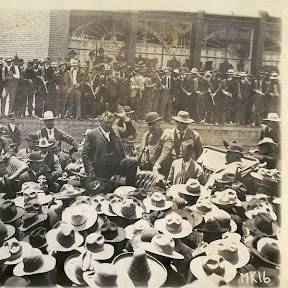
Colonel William Greene (with hand raised)
addressing striking Cananea copper mine workers
Mexico, 1906

The beauty at Sitka fairly takes Hayes’ breath away: “The gold mines at Juneau and Douglas may be more profitable, but Sitka has the transcendent beauty that one never forgets. It fronts almost on the open sea. Cut off by numberless tiny islets, it wanders about the rugged coast line and back into the forest in bewildering fashion.” Much of the architecture here is Russian and Hayes wonders why they ever gave up this vast territory rich in natural resources.

21.5 Hemmed in at Dundas Bay

June 22, 1903

Poking up the coast to Dundas Bay, the small ship gets hemmed in by thousands of tiny icebergs off Muir Glacier. They’ll have to wait for the winds to scatter them across the bay before leaving the small salmon cannery near which they are blocked.

The cold water makes the teeming fish life here tastier than in warmer climates but the cannery wants only salmon. There are so many, Hayes wonders where they all come from. Any fish not a salmon is discarded for the gulls. “This when Europe is full of starving people who never knew a square meal, yet so vivid in my mind.”

21.6 Yakatut Bay: Real Alaska

June 24, 1903

At Yakutat Bay: “This is real Alaska, with Indian women selling furs, mukluks, beaded moccasins, ditty bags, everything possible they know to make.” The world’s largest glaciers are on every side. Forty miles distant, though seeming only ten in the crystalline air, “is the famed peak discovered by Vitus Behring (sic) in 1741, I think it was.”

Vitus Bering,
Danish Navigator in service to the Russian Navy

One more short hop across the ocean and the expedition will have arrived at their base and begin some inland explorations.

21.7 Wingham Island

June 27,1903

When Hayes and Martin land on Wingham Island, place names mentioned in the Diary become confusing. Hayes refers to places with names used by the locals, while Martin continually renames them. So when Hayes says a scow immediately towed them from Wingham Island across to the mouth of the Chilkat River, a current map shows this as the Bering River – Martin’s names stuck.

On the scow, Hayes picked up another interesting name: “an ex-prize fighter, one Ed Smith, who was famed for defeating Joe Goddard, the Australian Barrier Champion, was working long-shore at the beach.”

”Denver Ed Smith”

Above the high tide line, the men set up a tent to hold back the voracious mosquitoes, “that are the curse of the north.” Hayes and Martin brought a small skiff from Seattle; the plan is to wander up and down the costal inlets, rivers and lakes of this roadless area looking for resources. Already Hayes can see coal-bearing rocks around what is now Bering Lake.

As Hayes frequently notes throughout his travels to the frontiers of European and American expansion, cultural contact usually is not genteel: “The white man has in Alaska crowded the natives out of all best places, has brought to them social diseases, liquor, and dishonesty.”

21.8 Exploring far Inland.

July 10, 1903

Traveling in the skiff and by hiking along bear paths pushed through “the jungle of devil’s club, tag alder and in the spruce forest”, Hayes and Martin explore where, “No maps have ever been made …. We are the first government party.” Hayes marvels at the volume of water cascading from the enormous glaciers: “there are eighty rivers in the thirty miles falling from the ice field between [the mouth of the Bering River] and Yakataga.”

By law no company can take more than sixteen land claims in this territory. But Hayes knows of one company with more than 1,500 claims taken by two men. “Talking to them, they told me they had difficulty in studying up names to put on claims.” If some mineral resource proves good on a claim, the company places a real homesteader there; if not, the claim lapses in a year. “There are four companies grabbing all prospects of coal, oil or anything else that may give evidence of remuneration in this district.”

During their explorations over the moss covered ground, at the edge of glaciers, and across torrential streams (Martin nearly drowned in one) Hayes feeds himself and Martin on ducks, geese, ptarmigan, and the salmon everywhere. Eagles and gulls gorge on the abundance of salmon and other small fish. “There are numerous bears, and the old Scotch foreman at the coal mines has killed eighteen of these splendid animals for so-called sport.”

21.9 Two Men alone in the Bush and Not Companionable

July 15, 1903

Down from the backcountry, Martin and Hayes push west to Catella River which Martin promptly renames the Katalla. The two aren’t getting along well. For Martin, “Everything must be done according to the book, and this goes ill when one must use his head as emergencies arise in the bush. He has almost caused us to lose our lives several times already.”

Part of the trouble stems from Martin’s inability to see Hayes’ expertise. At Katalla a number of frontiersmen gather as in a gold rush looking to get rich quick on coal or oil claims. As these men watch Hayes pilot the small skiff in off the ocean through the breakers at the mouth of the river, all marvel at his skill with a boat – but not the boss of their little two-man expedition: “Martin never realizes any danger, being inexperienced and foolhardy.”

Nevertheless, the money is good and Alaska endlessly fascinating so Hayes will stick it. At Katalla the mineral wealth astounds him: He describes many coal seams six to eight feet in diameter, and one reaching 27 feet. Not to be outdone, Martin reports one 63 feet in diameter near the glacier line. In addition to coal, oil seeps from the ground in a pool covering several acres. Hayes dips up a gallon to be sent to Johns Hopkins for analysis.


20. Liverpool to Washington DC

June 12, 2011

For this segment of the diary I am indebted to my newly found cousin Jean who contacted me when I first began publishing this synopsis of Hayes’ diaries.  On the Abbreviated Perkins Family Tree  you will see that Daniel Perkins was my great, great, great grandfather.  His wife was Lydia Banks Perkins.  Jean and I share these ancestors which I know because of Jean’s remarkable genealogical work on the Banks family.  At the end of this chapter, Hayes runs into a bit of great good fortune in Washington thanks to an aunt and uncle who give him a boost up.  In four diary entries, Hayes names neither the uncle nor the aunt, only his two cousins.  From this information Jean was able to identify Hayes’ Uncle Epaminondis and Aunt Jennie correcting my guess that it was his Uncle Thomas Jefferson Perkins and Aunt Eliza Jane Houghmaster Perkins.  Thank you Jean.

(If no map appears in the email, click on the title above to go to the blog page.)


Click here for links to maps and downloads of more maps.

Here and There Synopsis:


20.1 Broke in London

March 29, 1903

With only two pounds in his pocket, Hayes takes up worried residence at the sailors home at Dock & Wells streets, London.

Inside the London Seamans Home

“The Home Officials, … saw my penurious condition and told me candidly that when my money was gone I would be put into the street….” Hayes will see none of the sights in London this time through; “It is a matter of finding something to keep me from walking the streets starving. I’ll do my best, trust in God, who has never forsaken me.”

Together with an Australian lad, Hayes walks miles of docks up and down the London waterfront “seeking a place as work-a-ways, seamen or anything to any place in the world.” – Still nothing.

Just as they had given up, Hayes spied one more ship, the Allegheny. He knew (his emphasis) this one would take him. The dispirited Australian called Hayes a fool and collapsed into a nearby station. “The mate, gruff though he was, was kindly. He told me to get a permit from the consul, which I did, and we sail in the evening.”

20.2 Bull Pusher

April 4, 1903

All down the English Channel, the crew of the Allegheny puts off stowaways desperate to return to the United States. They deposit three at Goodwin Sands, two more in the Straits of Dover, and then two more off Plymouth.

The mate hired Hayes as a sailor and sent him forward, but Hayes must have arrived at the forecastle shabby of appearance and poor in health. The sailors wouldn’t accept him; they said he was a bull pusher. “Vosper, the mate, is angry, but I am willing to stay where I am.” This will mean considerably less pay for the voyage, but a sailor named Jackson, a bully, rules the forecastle and Hayes knows that trouble would result from asking an officer to intervene where a bully doesn’t want him. He can push bulls.

The next self-contradictory paragraph entered by a battered, world-weary, 25-year-old Hayes describing his bull pushing mates, encapsulates all the wisdom this mean life has taught him thus far: “My mates are drunken, lousy, filthy in personal appearance. They are degraded as only bull pushers may be, but having reached the depths, have ceased to hate those about them. They share their miseries, their few good things together as men should, and are more Christian in spirit than the ones who condemn them.”

For once at least, among the lowest of the low, Hayes finds something of humanity worthy of praise. “But it is cold, oh so cold!” The Allegheny follows a slightly northern route taking the ship more directly home than would a warmer westerly course.

20.3 Icebergs of Newfoundland

April 12, 1903

The Allegheny belongs to the Chesapeake and Ohio Railroad Company but flies the British flag to save money. “The boat is unseaworthy apparently…” She broke down for four hours, lying to in a gale, then some drums of creosote got loose below careening about so violently in the rocking hold they would have ruptured the hull had the crew not “managed to chock them with loose bits of dunnage, else they would have wrecked us.”

Fog lies thick in these cold northern climes off the banks of Newfoundland but on the morning of April 12, dawn broke unexpectedly clear. “When daylight came, we were in the midst of a fleet of icebergs, some of them huge mountains, others growlers, scattered on each and every side.” His tone rings more of admiration for the beauty of the sight than for the danger to the ship.

Iceberg Off Newfoundland

On this meager cattle ship, in the northern cold, “We are scrubbing paint as ever, like this ship was a liner…. My hands are like birds’ claws, so numb, so numb.”

20.4 Newport News

April 16, 1903

“If all goes well, we will be in Newport News tomorrow. I will be happy to be rid of her [the Allegheny], but what next?” A well-to-do uncle in Washington DC has been demanding a visit from Hayes next time he’s on this coast. Even in his reduced circumstances, disdain for anything to do with the family runs very deep, he says, “ I am going to see him for a day or two, then have that duty fulfilled for good and all. I have never seen any of them.” The idea that a wealthy, well-positioned uncle might be able to help him seems not to have crossed Hayes’ mind.

One middle-aged bull pusher served in the U.S. navy and receives $80 a month pension. According to Hayes, he ferries back and forth across the Atlantic tending cattle because, “he wants to stay where he is, taking the blasphemous abuse from the head pushers, the hard living and almost loathsome company with whom he associates.” His pension and all the money he earns goes to drink and riotous living ashore ¬– except for his expenses for periodicals; he shares the latest magazines and papers with Hayes and “sometimes unburdens his wearied soul.” Hayes says of all the bull pushers, “At least they can fall no further, and this brings peace to their sordid souls.”

As for peace to their lice infested bodies? “If they ever bathe I have not seen it.” However, hanging an article of clothing through the grating above the steam exhaust “soon kills all the livestock there. Thus they keep the vermin down without washing their clothes at all.”

April 18, 1903

In port at Newport News, all the bull pushers have gone to the groggeries ashore. Hayes has no interest there so doesn’t mind being ordered by the skipper to remain alone on the ship until clearing immigration. As it happens, despite sharing all their work, Hayes shipped at status even lower than bull pusher – as an unpaid “work-a-way.” The Skipper kindly gives Hayes 50¢ for his 17 days labor across the Atlantic but even that is essentially a gift to a work-a-way crewman. The 50¢, Together with $3 from selling his boots and oilskins to a sailor forward, his $2 savings, and a fair exchange on fourteen shillings and six pence, give him enough for a ticket to Washington with $5 left over. “At least there is a door to enter, but I dread it.”

20.5 Caught the Ferry at Fort Morgan

April 19,1903

At Fort Morgan Hayes waits for a ferry making the night run between Norfolk and Washington. Earlier, touring Fort Morgan, Hayes passed by the veteran’s home where old soldiers still in Civil War uniform caroused and drank showing exaggerated Southern civility to every passing woman. Then in the room waiting for the ferry, Hayes ran across the bull pushers from the Allegheny also carousing and drinking – though feebly; one day after de-boarding the ship, not one had money enough remaining for a real drunk. “… The rest of the passengers drew aside from these men as if they were unclean. No wonder, for all of them were blatant, loud mouthed, ribald in conversation and appearance.”

With a happy farewell to the bull pushers, Hayes boards a “wonderfully clean and well appointed” steamer, regretting only that the night ride will deny him the opportunity to see Chesapeake Bay on the ride north.

20.6 Fantastic Opportunity in Washington.

April 22, 1903

Landing in Washington, Hayes can find no seaman’s home to stash his “kit” before calling on the relatives. “Washington is not like other cities, it has no manufacturing, no workingman’s quarter, nothing but government offices and the homes of those who work for Uncle Sam.” He had no choice other than carrying his luggage right to the door of the three-story brownstone on Rhode Island Avenue. “I managed to slip my bag of clothes down under the stoop leading to the basement, so had my hands free on ringing the bell.”

Hayes writes four diary entries over the next month during his stay in Washington. In all four he names his older relatives only “uncle” and “aunt”. However, because he does name cousins Lydia and Adam, the astonishing genealogical abilities of my newly discovered cousin Jean, reveals that they were his father’s brother Epaminondis Daniel Moore Perkins and his wife Jennie Sanders Perkins. On answering the bell, Aunt Jenny did not recognize Hayes; “She was civilly polite and wished to know the stranger’s business.” One might add – the scruffy, ill-fed stranger in clean but ragged clothing – but apparently his aunt did not phrase it that way.

“To skip the details, I may say they could have welcomed me no more warmly than if I was their own son.” Immediately sizing up his lack of funds and “everything else in worldly goods,” and with tact enough not to offer charity, cousin Adam immediately found Hayes a job “to earn some money and leave town like a man.” Hayes has his eye on a railway job in West Virginia but, “Uncle says he can get me a place with the government, but I don’t see how he can.”

May 2, 1903

May in Washington, and “all is green now with the coming of spring.” Hayes and Lydia visit the halls of congress listening to, “the blather of the senators and congressmen.” He and Uncle Epam tour the White House, “but I did not see Roosevelt or any of his family.” And alone, Hayes walks the tree-lined streets, through the statues, and even to the top of Washington’s monument.

May 23, 1903

Uncle Epam must have had some powerful connections: “The impossible has happened. My uncle has wangled it some way, and I have a job with the geological survey in Alaska.” A lone geologist sent to that “far-off land” to investigate for coal “and anything else lying loose in that part of the world,” needs an experienced hand, “to cook, sail boats, to look after the camping and a general roustabout.” With returning health, good clothes, and the promise of an exciting new adventure, “the world looks rosy once more.”

June 2, 1903

On meeting his new boss, named G C Martin, Hayes, ever able to size up the bad in any situation, describes him as, “too eager and has a determined look that bodes no good in the end. He has a very large head for a man his size, for he is almost a pigmy.” But beneath all the dour caution, Hayes simply cannot contain his delight. “Is this what I have been looking for all these years? … I am one of the favored ones, it would seem.”


19. San Francisco to Liverpool

June 5, 2011

The rain in Eureka prevents Hayes from recovering fully from the ravages of his last trip around the horn,  so he rides cross country to see the family in Galveston and from there – signs on to sail to Liverpool again!

(If you aren’t seeing a map in the email, please click the title above)

Click here for links to maps and downloads of more maps.

Here and There Synopsis:

19.1 Loggings at the Slough in Eureka

July 10, 1902

After a week at the San Francisco ironworks, Hayes can no longer stand the noise. The bosses are decent about his quick departure and now Hayes has earned enough money to pay fare on the Pamona, a small passenger steamer sailing north to Eureka. Of course the dreadful seasickness strikes him down but upon arrival at Eureka, all there welcome him back, even George Glynn his old boss who has both a position and a promise of a better one to come.  Hayes writes, “I hope to stay on for a long time.”

August 2, 1902

“Time slips by pleasantly and quickly when one is in a congenial place.” Hayes moved out of town to where the logs are floated into a deep slough and made into rafts. He works with Wallace and Billy and “being adept as seafaring it gives me an advantage in handling ropes, wires and rigging in general.” When not on the log rafts, a three-mile walk into town takes him to the library where long quiet hours transport him to other worlds. “To get an education has always been my desire, but thus far it has been one of hard knocks instead.”

August 21, 1902

A small railway runs about ten miles back into the deep woods where the trees are cut. Two or three times a day, a railcar dumps a load of freshly cut redwood into the waters of the slough. The butts of most trees hold so much water the first log cut from a tree almost always sinks. “We bore holes in the sinkers, as these heavy logs are called, then hang them onto a lighter one of corresponding size.” The very lightest logs are pushed far up into the slough to save for winter cutting; the rest are ganged into rafts and towed to Eureka for milling.

October 2, 1902

With so many logs coming the slough is entirely full. “Many of the logs are so large we must blast them into smaller pieces.” The saw mill can handle logs no larger than nine feet in diameter; the largest Hayes has seen is sixteen feet, “and it had to be halved in the woods before it could be loaded on the train.”

Even in the midst of the cutting, all the destruction troubles Hayes. “ Sometimes it seems a crime to destroy all these fine forests. What will posterity think about it?” The cut stumps would rapidly re-grow but the company burns them to seed for pasture seeking short-term profit.

The wild world of Hayes’ childhood is rapidly vanishing: “There is not a tenth duck or goose. The elk are all gone; the fur bearing animals and most of the Indians are gone. Only at the Klamath reservation are there any number now.”

December 3, 1902

In this region of Northern California rain falls nearly every day. As Hayes is not yet recovered from the starvation of the Crown of India, “My teeth are still sore, loose, gums fallen away from the teeth and I fear of losing them all,” the severe weather may force him to leave this very comfortable position. Remarkably, he writes that he still sends all his money out repaying people he outsmarted years ago. “Business, of course, but it was unfair and must be returned.

December 26, 1902

“Christmas, and for the first time in my life I have been to a Christmas tree.” Of course he immediately downplays the evident excitement of this sentence writing that his gifts were trinkets that would have been appreciated when he was a boy, “but give little thrill at my present age.”

The rains swell the slough into a rushing river threatening to sweep all the stored logs out to sea. Dancing on the bobbing log rafts in hobnail boots on a rushing river requires great skill. “Strangely we cannot discern the various elevations of the logs at nights. Thus we sometimes step down two feet, falling overboard or jarring ourselves badly in the darkness.” When new men are sent to help hold the logs against the current, Hayes and the others must constantly rescue them from spills into the muddy waters.

Now comes a tree 28 feet across the stump. “We made 35 logs out of it by blasting it. Surely this tree must have been 3,000 years old, perhaps more than that.” Reading Hayes diaries more than one hundred years after this account, perhaps we know what posterity thinks of cutting and blasting to bits such a magnificent tree.

January 11, 1903

The Northern California rains won’t let his lungs, damaged on the Crown of India, heal – but where to go. Australia? Perhaps in that dry climate he will avoid the tuberculosis that killed several of his relatives.

19.2 Hico with the Family

February 10, 1903

Finally the pleurisy drove him from California – to Hico Texas for his 25th birthday.  Instead of Australia, he now thinks maybe he’ll go to South Africa where “the climate is dry and warm,” and mining work available.

His report on the family comes in the same laconic tones as before:  “Mother is getting old. …  I wish I might do something to aid her more than I do.”  Just this for his sisters:   “My sisters have grown up until I scarcely know them.”  And he has only disdain for his father, now moved to Oklahoma:  “Why a man should be inherently cruel to his children is beyond me, but he was.  It is over forever now, and he has lost the affection of us all.”  His sisters know that Hayes will again leave them shortly; they “chide me because I am given to roaming.”

19.3 Galveston and Back to Sea

February 24, 1903

His sister did survive the flood of 1900 at Galveston but much wreckage to the city still remains. In this Southern town, enmity concerning the Civil war also persists; “there is a certain coolness toward the Yankee who invaded their country and defeated them.”

Despite its tiny size, Galveston is a great port of the world frequented by many British ships but also those of Germany, France and Norway, hauling into stream, loading, and departing as fast as they can, one after another.

Hayes catches a job on the biggest ship in port, the Irak, preparing to leave immediately. His rationale for returning to work as a seaman while still sick from the previous trip is rings hollow: “I am not well, but the clean air of the sea should soon drive away the weakness I have acquired and make me well.” Hair of the dog? Or more likely his desperation to get free of the family: “’meeting my mother is like going to a funeral, she takes it so hard when I leave.” In any case, he sails with the Irak tomorrow.

19.4 Florida Straits.

March 1, 1903

As the Irak was leaving Galveston harbor a tidal surge tossed her against another ship, crumpling the railings on both sides. Neither ship sustained any real damage, but “There were many sweet compliments exchanged between the respective skippers…”

Surprisingly cold air hangs the Florida Strait with thick weather and poor visibility, but a strong current pushed the Irak smartly forward. The small sandy spits of the Bahamas and a quick glimpse of the Florida coast fleeting by indicate the swift passage of the ship.

19.5 Coaling at Hampton Roads

March 6, 1903

Fine weather past Cape Hatteras gives way to “a cold blast right out of the north.” The Irak drops anchor in the wide mouth of the James River with Hampton Roads to the south and Newport News to the north. Many ships stop here for Virginia coal and the Irak will also “take on a deck load of Cattle for Liverpool.” Building pens to hold the bulls on deck delays the Irak’s departure for several icy days. “We do have good food, poorly cooked always, but ample and would be excellent if a man who knew the rudiments of cookery was in the galley.”

19.6 Bull Pushers

March 8, 1903

The 458 bulls on deck headed for the British army boarded the ship as wild animals, “but the sea has tamed them.” Their tenders must keep them standing for the entire voyage for once down they will not rise again. “If there be a more picturesque crew than these bull pushers, as they are called by the sailors, I have never seen them.” These men have fallen to lowest position on the shipboard social scale and their pay reflects that status: $65 for a forty day trip with a second class return ticket for the headman and $25 with a third class return for his underlings. The seamen despise the bull pushers but for Hayes they provide an opportunity to admire a new “fluency in cusswords.”

Fortunately Hayes draws the port watch under a genial Irish mate. The scurvy still weakens Hayes and when the mate sees him struggling with heavy work in seas breaking over the forecastle-head, rather than curse him as Fleck would have, the mate sensibly re-assigns Hayes to lighter work.

19.7 Mid-Ocean with Bulls on Deck

May 12, 1903

All the bulls have great horns, so when their pens break down in heavy weather, even those bull tenders not down with seasickness are afraid to try corralling them. “I was too at first, but one seemed so cowed I petted him a little, then took hold of his ear and led him into a stall farther aft.” Soon Hayes working with another Swedish sailor have the bulls all safe in new pens.

After describing the line dividing the Gulf Stream and the Labrador Current as deep blue on one side and light green on the other, Hayes relates some kind of prank that involved painting some of the bulls. He and the Swede had been detailed to paint the insides of all the deck ventilators. He’s not clear about how the paint got on the bulls, but the head bull pusher speaks to the mate in no uncertain terms: “These bloody souji-mouji artists of yours … have ruined my cattle. Wotta hell you keep such punks for is more than I can say! Now they’ve gotta git it off before I am back here. See to that!” The mate sharply assents to the demand, but he’s “grinning at me out of the corner of his eye,” and nothing more is said.

19.8 Paid off at Liverpool

March 19, 1903

Sailing through wild stormy weather, Hayes took quite a shock on the the Irish sea: “I was on the lookout last night, the sleet driving in my face right out of the north. Suddenly a light appeared dead ahead. Too bright for a ship, it seemed like a search light from a warship. I leaped for the bell lanyard and had just reached it when the light jumped twenty feet up the forestay. I hesitated. The light began to move slowly up and down the stay, remaining there for some minutes. It was St. Elmo’s fire, the first time I have ever seen this phenomenon.”

All the bulls but one were happy to disembark the ship at Liverpool. “For three hours he held the fort, the side captain cursing in every tongue he knew until he could speak only in a whisper.” When the mate tried to help out, he collapsed laughing upon receiving whispered curses from the side captain. Finally, they roped the renegade and winched him off the ship.

At payday in England by custom wives collect half a seaman’s salary, “to prevent their spouses from spending their substance in riotous living with the women of the streets and in the pubs.” As he is unmarried, Hayes collects his full pay and takes up residence at the sailor’s home run by missionaries.

March 22, 1903

Now that Hayes is finally ready for Africa, he can’t find a ship. Well, one, the Burutu would have taken him in return for a bribe, but it carried liquor to West Africa. Hayes won’t pay the “pour boire” and, “I don’t care to carry liquor to anyone.” According to Jack O’brien at the Sailor’s home, 50,000 other men are looking for ships out of Liverpool. “I have walked these docks form Hornsby to Herculaneum, seven miles of waterfront, seeking a place on a ship.” Nothing.

March 25, 1903

With a dwindling purse and no ship in sight, Hayes decides he might have better luck in London. Jack O’brien warns of fewer jobs there but Hayes has to move – here all the ship’s mates sign only sailors they know or those willing to pay the bribe.


18. New York to San Francisco

May 28, 2011

In 1902, it was cheaper to sail south to Panama, ride the train across the isthmus (before the canal), then sail up the coast to San Francisco than pay rail fare across the continent; so Hayes took the sea route despite an ongoing insurgency in Panama.

Click here for links to maps and downloads of more maps.

Here and There Synopsis:

18.1 Sailing for Panama

May 27, 1902

In 1902 sea travel was less expensive than land travel; accordingly Hayes booked passage on the S.S. Finance headed for Colon, Panama. The canal across the isthmus has not yet been built, but a short train trip will take him across, then another ship up to California. He travels with a number of Chinese immigrants on their way to new lives in Peru and eight others enroute to San Francisco.

“What interests me greatly is the outbreak of a volcano in Martinique in the West Indies.” As the S.S. Finance left New York Harbor, a ship entered, “all burned down one side,” having sailed out of the harbor at St. Pierre, Martinique just ahead of the volcano that, “broke forth with all fury, destroying the city and killing every inhabitant in the place.”

Mt. Pelee, Martinique
”the worst volcanic disaster of the 20th Centruy”

18.2 Among the Bahamas

May 30, 1902

Sailing south past Cape Hattaras, the northern cold gives way to the “balmy sunshine of the tropics.” Now among the “sandy and uninteresting” Bahamas, the ship’s passengers see many small local boats as they sail quite near some of the Islands. “One, Watling’s Island, is said to be the island Columbus landed on when he reached the shores of the American continents.” (In1986, the US National Geographic Society suggested Samana Cay, just southeast of Watlings Island, as the island Columbus named Guanahani.)

“How I would like to see the new volcano!” Unfortunately, the S.S. Finance sails too far west for a look. This is not a sightseeing ship, but “all seems so lazy-like and comfy after the hunger and hard work of the Crown of India, or even the bitter bleakness of the Campania. For no care is taken of immigrants into the U.S.A. They are treated as cattle, or even worse.”

Only the reports they heard in New York of fighting in Panama mar the Caribbean idyll.

18.3 Panama Before the Canal

June 2 , 1902

Hayes starts out describing Colon, Panama in what seem to be glowing terms: “The coast of the South American Littoral is one of luxuriant greenery passing anything I have ever seen.” He goes on about the jungle crowding to the edge of the sea, and bursts of tropical rain. But then the paragraph ends with an abrupt change of tone: “It is sultry, hot, and depressing. The atmosphere is one of death.”

Razor back hogs wallow in the muck beneath huts on pilings, vultures dot the trees, and, “there are soldiers everywhere.” Child soldiers as young as twelve carry muskets and “some of the officers are barefoot and carry cane knives for swords. A towel round his waist completes his uniform.” Hayes seems to be relieved, for his own safety, that these are Columbian troops. He writes no explanation for the insurgency, noting only that the Columbian troops retook Colon and Panama.

Passing by Cuba, Jamaica, and Haiti on the way here, dust from the volcano lit the sunset skies, “The entire heavens were covered with a dull red glare.” But no one in Colon shows any interest; everyone here talks only of the war.

“The canal started by the French enters the Atlantic at this place. It is little more than a muddy ditch, and machinery is rusting away all about the place.” A little desultory work continues but only to keep the French option on the job alive. US work on the canal will begin two years later in 1904. But for now, the failed French attempt only adds to Hayes’ perception of Colon: “Over everything is an air of death and decay.”

18.4 Off Flamenco Island

June 4, 1902

The train carrying Hayes and the others bound for San Francisco moved slowly across the Panama Isthmus guarded by two cars full of soldiers of all ages, “from grey heads to boys not grown.” Along the way the train passes, “much machinery rotting and rusting away where the French have tried to dig the big ditch.” The jungle will soon undo all their efforts unless new vigor arrives.

Disease rages in Panama City, “It is said there are six hundred cases of small pox in the town,” also yellow fever and Changres fever – all this on top of the war. Hayes describes Panama City in terms perhaps even more bleak than Colon.

Safely aboard ship lying off Flamenco Island, the eight passengers headed on to San Francisco on the freighter Leelanaw hope to have escaped the city without contagion. The cruiser Philadelphia lies near them, and in the shallow waters near Flamenco Island, the masts and smokestack of the Chilean passenger ship Lloa, commandeered by the Columbian government and sunk by the insurgents, still protrudes above the calm waters.

Shipboard romances have already begun. Cramped quarters in the freighter push together, a Portuguese family of three, Hayes and two other men, “and two girls, one a Finnish beauty who has a black eye handed her by a passionate steward whom she tempted on the Finance on the way down. The other, Margaret, is a girl of the streets who is making the run from the east coast to the western slope to seek better pastures.” The Finnish beauty tried to “establish more friendly relations” with Hayes but with only $2.50 left to get to San Francisco, he rebuffed her. “One finds only trouble in such transient joys, and I don’t want more than I already have.”

18.5 Slipping up the Central American Coast

June 7, 1902

Calm waters, no work, glimpses of the Central American jungles, sea turtles, the occasional shark – Hayes settles down to shipboard gossip: It looks as though Anna, the girl from Finland, will settle for the “genial bald headed Swede,” who is engineer on the ship. Much ill–will seethes between the two women who must share a berth.

June 10, 1902

More gossip:  the steward separated the women, “to avoid murder, mayhem, assault and battery or whatever is in the offing, perhaps all three.” And “Anna has the steward roped, hogtied and branded.”

Of slightly more interest, Hayes sights a great waterspout caused by a cyclone at sea.

June 16,1902

As often when life is calm, Hayes comments on the wildlife around. Off the Lower California peninsula are: pelicans, cormorants, gulls, gooneys, giant jellyfish “some with long trailing arms thirty feet in length,” countless fish, sea lions and “the ever present porpoises that play about the ship’s forefoot.”

June 20, 1902

Passing Cedros Island, Hayes reflects on the courage of the early European sailors, “who in their tiny caravels explored these barren lands.” How much more trying the adventure must have been for those men even compared to the starvation and abuse Hayes endured on the Crown of India.

June 25, 1902

In fog off the Santa Barbara Islands, the Leelanaw nearly runs aground on what Hayes thinks was Santa Rosa Island. “The skipper knocked the Greek seaman from the wheel and threw it hard over, thus avoiding the crash that would surely have wrecked the ship.” The rough seas have also interrupted the romance of the engineer and the “voluptuous Anna,” who has gone below decks suffering seasickness.

Where to go next? Look for another deepwater ship in San Francisco? That seems like a fool’s game when still weak with scurvy from the last trip . “The $2.50 in my pocket will not take me far, but something will turn up. It always has.”

18.6 Back at the Iron works

June 30, 1902

Mrs. Emslie’s mission and the old job at the iron works provide a temporary safe haven. “The scurvy from the Crown of India lingers, my teeth are loose, my joints seem weak and painful.” But the long, tough voyage around the Horn earns Hayes new respect from the bosses at the iron works; they assign him lighter work until his strength can return. The wealth of fruits and vegetables available in California further speed his recovery.

The union wars, wracking the city when Hayes left to sail south, have now been won by the unions. Their candidate, Eugene Schmitz, a musician, now holds the mayor’s seat. “Then there are a horde of laborers, carpenters and so on who are ignorant, illiterate men, acting as statesmen… Even were they fit, or even honest, then their inexperience in government would make them unfit for the places they hold.” Hayes will not stay long in this town.

July 4, 1902

San Francisco celebrates the national holiday with “firecrackers, parades, and noisemakers.” Perhaps to find something more meaningful, Hayes accompanied a Mr. Paulsell and several missionaries to the Barbary Coast. The locals showed respect, even deference, until one of the missionaries started preaching about their wickedness. Having seen a lot of hard living and the difficulty of rising in the world without self respect, courage, and hope, Hayes remarks that those on the Coast, “Are little, if any, worse than the rest of us.” Perhaps his bible reading teaches him about who should and should not cast stones.

He cannot help but see the slave girls and opium dens of China town, but his revulsion is directed more toward the tourists who “gleefully pay a dollar, or five dollars to guides who take them thru the purlieus.”

All this brings him back to his very dark opinion of humans: “The more I see of men the less I think them worthwhile. The so-called lower animals are exalted by comparison….”


17 Falmouth to New York

May 22, 2011

Which is more extraordinary, sailing on board a ship intentionally grounded on the coast of England?  Or sailing across the Atlantic while Marconi performs radio experiments on board?


Click here for links to maps and downloads of more maps.

Here and There Synopsis:


17.1 Never Again

April 16,1902

Everyone on the Crown of India celebrates the end of this gruesome trip: Captain Sauter and his wife pound the piano they bought with “the proceeds of the food we should have eaten on the voyage;” Fleck taunts the men and “boasts of having taken all we have to give on this voyage;” and the crew buy drink, cigarettes, socks, and clothing on advance against their pay at Hamburg from the “bumboat” sharks who board the ship having negotiated a split with the Captain.

Hayes buys “a couple of cans of tinned milk that tasted wonderfully well,” and swears he will never again sign on as a sailor on a deep-water ship. Fleck’s sadistic taunting accurately describes the broken crew. Hayes writes, “All I can do is return home and try to regain my lost health, for to ship in another like this would kill me.”

At twenty-four, having roamed the world for nine years, twice sailing around the horn, never staying for more than a few months in any one place, one wonders what Hayes can possibly mean by “home.”

17.2 “Ful-an’-by! Right Over Ole England!”

April 30, 1902

The celebration turns out to have been premature. “A dead muzzler right down channel” prevents the ship from sailing north to Hamburg. “We have been beating up channel for near a month now, making a few miles then blowing out to sea and back again, a heart-breaking task if there ever was one.” Scarce food and futile work once again haunt the ship.

Then Fleck makes a mistake. Hayes’ port watch under Fleck’s command stumbles on deck at 4:00 AM preparing to join the night watch to turn the ship as it approaches the English coast for a tack back toward France as, “has been the custom for days on end.” But Fleck sends the night watch below, choosing to turn the ship as it sails closer to England. Fleck leaves orders for Juan Guerrero at the helm to sail “full and by the wind,” and a “sleepy Englishman … on watch as lookout,” before going below himself.

An hour later, Missouri and Hayes chat with “Chile” as the Swede Schillerstrom arrives to take the helm so Guerrero can go for coffee. Then, in the breaking light of dawn, “ I saw we were almost on the land, and ran forward to call the crew while Missouri endeavored to get the mate.”

The crew turned out to mill about the deck awaiting orders. Hayes ran back to the poop where Schillerstrom still had the wheel; no mate had yet arrived to give an order. Hayes caught “the roguish eye of Schillerstrom as he stood at the wheel,” still sailing straight on course toward the Dungeness light dead ahead. “Ful–an’–by! Full–an’–by th’ wind! That’s my course. I’m a–goin’ to run right over ole England if she doesn’t get out of the way!”

Fleck, “not realizing the seriousness of the situation,” arrived on deck just as the Crown of India drove onto the low sandy mud of the beach. All sails immediately fouled, blown back into the rigging of a ship run aground. “In a short time the decks were full of coastguards, tugboat men and many others wishing to be in at the kill.”

Oddly, Schillerstrom bears no responsibility for the grounding, “for orders are orders with a sailor and must be obeyed.” Captain Sauter furiously commanded Fleck out of sight below deck before trying “every method he knew to get the ship off the ground.” When none of Sauter’s tricks work, the tugboat captains gleefully offer Captain Sauter 3,000 pounds to pull her off the mud.

17.3 Behind a Strong Tug

May 2, 1902

Schillerstrom ran the Crown of India aground at low tide. An eighteen foot tidal rise lifts her free from the sand scattering the tugs hovering nearby. Now that the ship floats free again, a German tug, the Atlas, offers to tow her the 650 miles to Hamburg for 140 pounds. Sauter accepts and, beating steadily north past hundreds of ships, despite the cold, “it seems as if we are on holiday.”

Fleck still glowers behind Captain Sauter’s back, but he “is reduced to a mere passenger now, and the sailors are no longer afraid of him.”

17.4 Human Again

May 5, 1902

On their last day in the North Sea a favorable wind rose. Crown of India set some light sails and nearly ran down the tug Atlas. After a frantic signal to “shorten down,” both ship and tug turned up the Elbe passing Helgoland Island, Cuxhaven, Brunsbuttel, “and numerous towns and villages along the 90-mile reach between Cuxhaven and Hamburg.” The German landscape appears tidy and prosperous to Hayes with “a red-cheeked maiden busily knitting,” behind every flock of geese.

The mighty German ships headed downriver, “to China, to Australia, to New York,” testify that, “Germany is now a great and wealthy nation, proud of her place in the world and determined to surpass all others in her lust for power.”

Arriving at Hamburg, “a horde of thieves descended on us.” Hayes was able to corral Missouri and Charlie, a German-American lad, toward the German sailors home run by missionaries, but every other sailor on board found chaperones from, “houses of ill fame, brothels low and brothels high, boarding houses and bars.” While the others begin their riot in the fleshpots, Missouri and Charlie entrust Hayes with their gold sovereigns and the three treat themselves to, “a decent meal, clean and served as if we were human instead of lower than beasts.”

May 7, 1902

Charlie came for a pound, then later, despite Hayes’ remonstrations, “he took a couple of sovereigns and I have not seen him since.” With the location of the Seamanshaus, “in the quarter called St. Pauli, which is the sporting district of Hamburg,” Missouri hears the siren’s call too. “He was smitten with the ample physical charms of the Teutonic damsel and despite my efforts to ride herd on him he succumbed.”

Rising alone the next morning, Hayes tours Hamburg on foot, marking his way by a distinctive street sign, “Haltestallederstrasseneisenbaun.” After walking miles to Wandsbek, Haltestallederstrasseneisenbaun (which means something like trolley stop) appears on several different streets, heading in several different directions. Lost for the entire day, Hayes made it back to the seamanshaus just in time for the last of the five daily meals, “we receive for the modest sum of five marks per day.”

May 8, 1902

The sovereigns spent so far have been advance against payday – today. The entire crew showed up, many with “contusions and torn clothes,” but none worse than Juan Guerrero who, “tried to defeat the entire police force of Hamburg after tanking up on the fiery beverage served him at his ‘home’.”

With his pay each man receives a discharge order, based on ability and conduct. Most of the crew receives honorable discharge; only two sailors receive “decline to report” (Hayes’ quote) for ability but not conduct. However, Hayes is close enough to hear that Fleck receives “decline to report” for both ability and conduct. Captain Sauter fired him.

As the crew return to “the joys of St. Pauli,” Hayes continues to walk the city bumping into some other Americans – from Utah. “Why don’t you ask us how many wives we’ve got: all the rest do.” Hayes smoothed over this irritable remark and accompanied them to the docks where they met eleven other missionaries bound for Sweden. One of the young girls was pretty but he declined an invitation to visit their chapel.

At the Hamburg-American Line office, it turns out that a ticket directly to New York costs more than a detour through Liverpool continuing on by Cunard. So Hayes buys the cheaper ticket and one fro Missouri too who, “is repentant because of his folly in wasting his substance in riotous living.” Hayes’ other mates, Chris, Albert, McCusker, Schillstrom, and Chile show up, “trembling from spiked booze, from fighting and general dissipation in the bagnios of Hamburg.” The Crown of India sailed 176 starving, tortured days around the Cape Horn; after three furious days in port, most of her crew already need to find another ship to finance the next binge.

17.5 Spring on the Elbe

May 10,1902

Hayes and Missouri pay for passage on the British ship Warrington enroute to Grimsby, England. Spring on the Elbe pushes green grass and buds on the trees.

With no particular rancor, Hayes reports that Fleck is also sailing on the Warrington. He’s tame and speaks civilly claiming the skipper mistreated him by giving the bad discharge. “One would never realize he is the same man. Perhaps it will do him good, but he is rather old to mend his ways now.”

17.6 Stopover at Grimsby

May 12, 1902

“Three West Indian negroes, an old sailor who is as grouchy as they make them, and a couple of Jewesses from Galacia,” round out the passenger list on this “vile, rotten,” ship. When the old sailor stole Hayes’ one outfit of clothes, “the three big blacks barred the door while everybody in the forecastle turned his bag inside out.” All concerned lectured the old man, but “he was too old to turn over to the police, they would have used him hardly.”

“Grimsby is a drab town, redolent of fish smells and ragged, ill kept women.” But Hayes does admire the sailors here. They catch more fish than anywhere in the British Isles going out in all manner of seas in small craft with waves constantly dashing over them even in light weather.

17.7 Longing for Eureka in Liverpool

May 12, 1902

Liverpool “with its grimy waterfront and smoke,” rates no higher than Grimsby as a place to live. When longing for home back on the Crown of India, Hayes meant Eureka, California. After his mistreatment at sea, the mill manager Gill now seems like a quirky, congenial fellow by comparison to the likes of Fleck.

And an after thought from Hamburg: In the Seamanshaus hung pictures of crooks wanted by the German police. Among them Hayes recognized Dublin, the brawling Irishman from the Austrasia, now wanted for broaching cargo. The sailor’s hard life has already taken its toll on Dublin. “In a few years Dublin will have come to an untimely end despite his great strength, for he burns the candle at both ends.”

17.8 Marconi’s Wireless Contraption

May 16, 1902

Still in poor health, Hayes has no thought of signing on with a ship out of Liverpool. Instead, he and Missouri purchase tickets on the Campania, of the Cunard line. Quite by chance, Guglielmo Marconi, the Italian physicist and developer of the radio telegraph, also happens to be sailing on the Campania.

Guglielmo Marconi

“We have a notable in the person of one Signor Marconi, who is Italian in name, but is half English. A dark man, black and tousled hair, with deep, dark eyes. Handsome, I would call him. He seems so intense, for he is making an especial experiment with a wireless contraption slung between the masts. The sailors curse him and his invention heartily, calling it the ‘Macaroni System’, after its inventor. By this method he can send messages across the sea without wires, so he says. It is clumsy, cumbersome, has to be taken down every night and put up mornings. In port it comes down, and keeps the sailors on the hop a good part of the time.”

In addition to Marconi, the Campania carries many Irish, Poles, Russians, and Scandinavian immigrants, none of these described as quite so handsome nor quite so clean as the Italian/English inventor. To the immigrant girls, Missouri is something of an attractive novelty. “He never worries, like I do, for he always trusts in some beneficent angel to drag him out of the messes he gets into constantly.”

17.9 A Horseless Carriage in New York

May 24, 1902

Missouri disappeared before dawn on the day after the two arrived in New York.
Perhaps the bedbugs in the room on Hudson Street chased him away, or maybe he was tired of Hayes’ protective hovering. In any case, Missouri is gone and Hayes is on his own in New York.

Their trip with Marconi on the Campania established a new speed record, five days, sixteen hours, for westward Atlantic passage. Her sister ship, the Luciana, still holds the record going east. Germany has some fast ships too, all named for royalty and nobility: “such as the Kaiser Wilhelm Der Grosse, the Kron Prinz Wilhelm, Kron Prnizessen Cecille, Eitel Fritz and all the rest of the royal family.” When he was in Germany, swell-headed citizens boasted of war, “ridiculing the Americans at Manila and in Cuba” Soldiers and sailors stepped smartly everywhere about Hamburg. Already, in May of 1902, Hayes writes, “I wonder if there will be war.”

Not far from his rooming house, the very tall oddly shaped Flatiron Building begins to rise on a stone and steel foundation.

Flatirons Building 1903

And past this construction site chugs a bizarre new machine Hayes has never before encountered: “I see strange vehicles steaming up and down the main streets that do not have horses to draw them. These are called horseless carriages , or automobiles. They make a chug-chug sound like a motorboat, with blue, stinking smoke coming out behind. It costs ten cents to ride up Fifth Avenue on one of these cars. The horses shy at them, though are not scared at other city traffic. I like the street cars best, but have little money to spend on them or anything else.”


16. North From the Horn – Starving

May 13, 2011
.


Click here for links to maps and downloads of more maps.

Here and There Synopsis:

16.1 The Great Rocks of Diego Ramirez

January 22, 1902

The Crown of India sailed past “the great rocks [of] Diego Ramirez” with good wind “under topsail yards all hauling.” Moss grows on the deck from the constant damp and, even at midsummer this far south, one may not look directly into the cold wind. With a little snow that falls on deck Hayes musters the energy to throw a few snowballs at a shipmate “Missouri.” All the men have “our fingers crossed lest bad wind spring up and we blow back west instead of passing the Horn.” But for now “Cape Horn is in a quiet mood for once.”

Unusually good weather, and, almost as welcome, Fleck is still below deck nursing his eyes. All the men wish him a long and painful illness lasting at least until they are safely round the Horn. Hayes is “shocked because at heart I agree with these men.” Because of Captain Sauter and his wife, every sailor on board starves on “pound and pint” rations, nevertheless all respond well to his just treatment.

“There are worlds of sea birds,” down here at the bottom of the world, from the tiny petrels “that really walk on the water” to giant albatross that “flap and run far over the sea as they endeavor to arise.” Despite the “fishy taste and coarse flesh,” catching a few for the stew pot compliments the short rations.

16.2 Shaving on a rolling sea

January 30, 1902

On the night of the previous entry, all the crossed fingers on board did not prevent a fierce gale from blowing up, forcing the crew up into the wild riggings to strip the sails. But at least the two-finger charm prevented the worst: the ferocious winds blew from the south pushing the ship smartly north into warmer weather. After a week running before this storm, Hayes and some other men “heaved the log” to gauge ship’s speed. All eleven knots ran out before their hourglass drained, “which means she is doing better than eleven knots per hour, and is almost under bare poles.” Of course, “food at its worst and growing worse daily,” and the rough seas wet everything aboard ship.

With the rough weather, the second mate hasn’t been shaved since the ship reached the Horn Latitudes on the west side. Despite the big rollers following the storm, Hayes agrees to barber. Both men brace themselves in the mate’s tiny cabin on the rolling ship with three hands on shoulders and one free to handle the razor. “We made it, but I scarred his face a little.” For now, “the men keep cheery in the forecastle despite the hardships.” The poor food, though, will become a real danger to all.

Fleck’s eyes have recovered enough that, “he imagined he could see the loom of the Falkland Islands” when he came on deck for the first time in nearly a month. With no real expectation Fleck has reformed, Hayes remarks that he “spoke to me in an even voice,” – an aberration, no doubt.

Evidently sailors frequently succumb to “Cape Fever” sailing around the Horn. Schillerstrom, the reckless Swede and comic of the ship says with a straight face, the one time he had it, “Eet was very bad, very bad.” Nothing like the real affliction Fleck suffered, men with Cape fever seem, “to eat well and sleep well, but are unable to work until clear of Cape Stiff.” Luckily, no one on board caught it this time round.

16.3 24th Birthday at Sea

February 10, 1902

Only the elements celebrate Hayes’ 24th birthday – “in fine weather now.”

How quickly Fleck has recovered his spleen. At 35° from the equator, hints of the southwest trades flutter the sails, “and Fleck is frigging the watch, hauling, trimming, sweating every rope in the ship,” pretending to catch these favorable winds. With Fleck returned to his cursing, beating, and kicking the crew, every man aboard swears he’ll never “again go deep sea.”

16.4 Even the Rats are Hungry

February 22, 1902

“Full rations are a bare subsistence,” and now the crew of the Crown of India is reduced to half. One can eat a shark, but not when prepared by this cook. “We have even considered the numerous rats the big cat in the hold drives on deck.”

The starving rats do severe damage to the ship: they eat the sails when stowed and even when furled, get into the cargo casks, chew the straps on the life preservers, and worst, chew on the feet of sleeping men. “The old Dutch cook, who is a sound sleeper and has corns, bunions and calluses on his feet, is unable to walk because of so much rat gnawing.” While dozing on the graveyard watch, a rat bit Hayes’ bare foot and, “it bled freely.” All men hate the rats and drive them overboard – thus far, no one seems to be eating them.

Least of all, the captain; he sold the crew’s food but not the officer’s. Because Hayes is handy at so many skills, he sometimes helps the carpenter, “and this takes me on the poop where the skipper plays with his much loved wife.” The careless skipper, coming too near a hammer stroke, dodged sharply sending his cork hat over the side. This brought Hayes a stern glare from the skipper and an appeal from the skipper’s happy well-fed wife to stop the ship, lower a boat, and retrieve the hat slowly receding from the ship on the calm seas. The skipper knew better than to ask starving men to delay their return home for his own folly.

16.5 Doldrums Past the Line

March 5, 1902

On deck, the second mate calls Hayes to see St. Paul’s Rocks, a small archipelago of granite rocks, flocked with birds, standing out of the sea, “almost on the equator and equally distant from South America on one hand and Africa on the other.” It is so hot here, “the pitch boils out of the seams in the decks.” More of the rain they caught for storage crossing the equator would be a welcome relief.

The starving crew can barely work. It’s a good thing they have water. Skip reading the following description of their rations if you have a light stomach: “our daily allowance now is a small portion of fat, yellowish pork and a mess the cook makes out of the sweepings of the biscuit tanks in the hold. These are half weevil larvae, wriggling like maggots and of similar appearance.”

Fleck is back to full form, frigging the men “until our flaccid muscles are worn out.” No one has energy to curse him; all move about “as if half dead.” As an officer, still on reasonable rations, Fleck has plenty of energy to fill in for any insufficiency of curses.

16.6 Beating North Into the Wind

March 20,1902

With her foul bottom, the Crown of India, can’t make headway against strong winds. They sail east half a day, turn the ship, then sail west half a day, tacking back and forth against the wind. She sails plenty of miles – while making almost no progress north toward home. The skipper restrains Fleck who still delights in frigging the crew. How can the cruel mate be unaware of the real danger to a ship worked by a crew too weak to stand? Doudou, a young German boy, “is first to break. He is semi-conscious, partly from fear of the brutal mate.”

16.7 Scurvy at Ponta Delgada

March 27, 1902

At Ponta Delgada on the island of San Miguel, the Crown of India lies in a small stream with the men gazing over green, well-tended fields, longing to be off this starving ship. A basket of oranges and a “lean beef” come over the side but disappear immediately aft for the officers. Perhaps the oranges indicate the skipper fears scurvy aft, this sailor’s malady, due to lack of vitamin C, already spreads among the crew. Hayes reports sore teeth but no swelling of the lower limbs – either is an advanced symptom of scurvy. Finally, “even Fleck has softened.” What’s the use of yelling at men who “move because we have to, instinctively rather than obedience to the officers of the ship?”

Some of the locals speak English. “It is said that there are some 9,000 priests, monks and nuns in this small town of only 16,000 population.” His observations about the large families and the power of the church are not flattering.

“For days we have been trying to contact a ship, the flag flying upside down, the symbol of a ship in distress.” Many ships pass, but none stop to offer aid. All can see that Crown of India is “a homeward bounder.” Their captains know “the ways of skippers who sell the crew’s ration and spend the proceeds on themselves.” Some of the men have collapsed from scurvy.

16.8 Finally, Some Cabbage

March 29, 1902

Captain Sauter must have procured some food at Ponta Delgada, the ship left the narrow stream and “a great feast was enjoyed aft.” And for the working crew forward? “The thrifty skipper let us go 24 hours without feeding us.” Some cabbages left over from the feast aft hung briefly for storage “under the bridge near the break of the poop.” All but a leaf and a root vanished in the night to the starving crew. When the captain finally produces some boiled beef and pan tiles for the crew, Hayes’ teeth are so loose from the scurvy he can scarcely eat.

Of course, with a little food in the crew, Fleck’s abuse returns. “He has the filthiest mouth I have ever listened too, and his spleen is always being vented on the man nearest him.” At least the ship is making headway toward Falmouth where this nightmare trip will finally end.

16.9 The End is Near

April 6, 1902

Landfall at the Scilly Islands “raises hope in our hearts that the end is near.” Now these abused and physically wrecked sailors speculate what they’ll do next. Most plan a visit home; Chris, a shipmate from Trondjehm, has patched his clothes and saved his money for a reunion, but admits, “It will be the same old thing, I guess.” Juan Guerrero, another shipmate, succinctly describes this same old thing: “enjoy the fleshpots of whatever port we make, then go out and make enough to do it in the next one.”  Guerrero, a Chilean adventurer, who has hunted rubber in South America, explored the Pilcomayo River in Argentina, faced a jaguar aboard ship, and quietly sailed the world draws this praise from Hayes: “A better shipmate than most of the crew, he is.”

16.10 Falmouth

April 8, 1902

Falmouth at last. “Every man among us are wan and broken by the hardship and hunger of this unlucky ship we want to leave.” By comparison the “ruddy-faced Englishmen” coming on board look hale and fit. The Englishmen bring food, “but it will require months to renew our health after the starvation of the past few months.”


15. South to the Horn

May 6, 2011

At the iron works in San Francisco, a general strike makes the city too dangerous, so Hayes signs on with a hungry four masted sailing ship for another tour around Cape Horn.

Click here for links to maps and downloads of more maps.


Here and There Synopsis:

15.1 A city on Strike

May 12, 1901

The mill superintendent’s browbeating at Eureka finally became too much. Hayes paid passage down to San Francisco on the steam schooner Santa Barbara, “and was seasick as a dog.” Upon arrival he found employment as a sheet iron worker’s helper at the Union Iron Works. “Pay is poor. $1.75 for ten hours.” On this slim salary, anything beyond bare living expenses still gets sent off in reparation for the misdeeds of his youth.

Still trying to live decently, Hayes finds rooms with Mrs. Emslie who runs a mission to women working the infamous Barbary Coast where business booms with soldiers coming and going to war in the Philipines, seamen from merchant and whaling ships carousing, and “especially Alaska fishermen.” Mrs. Emslie’s mission seems a fool’s errand to Hayes. As far as he can see, the women don’t want to rise. “They jeer those who would help them.” Nevertheless, Hayes stands with Mrs. Emslie in the streets enduring “catcalls and jeers” as she entreats all to a better life.

June 20, 1901

The iron works employs more than 5,000 men building “three torpedo boats, a cruiser, and several merchant ships … there is even a submarine, said to be the first of its kind,” and plenty of repair work. Hayes’ ears ring continuously from the constant hammering.

USS Grampus, one of two submarines
under construction at Union Iron Works in 1901

Labor unrest wracks almost every industry in San Francisco except the iron works. “The machinist, the boiler makers, and many others are on strike.” Replacement workers shipped in from Pittsburg run such a gauntlet of abuse from the strikers that the companies must quarter these “scabs” inside their workplaces. As an ironworker, not yet part of the strike, Hayes may pass the lines but not without surly bluster from the strikers.

July 6, 1901

Now the strike has spread to the teamsters and the seamen, paralyzing the entire town. “All workmen in the city are out now, and hoodlums are ruling the roost.” Perhaps if local police appointments reflected “their integrity as citizens” rather than fealty to the Catholic Church, some order could be instated. Corruption from top to bottom cripples the city.

15.2 One Soul Saved

July 27, 1901

Should the unions decide to run a labor candidate for mayor of San Francisco he would surely win. “Even the street sweepers have their union, the newsboys and up from there.” Workers and scabs clash by day and nightfall cues generalized violence and lawlessness.

Astonishingly, the ironworkers remain on the job. Nevertheless, Hayes’ work partner Risberg meets a mob of strikers on his way to work who beat him up – “for practice.” As an aside Hayes adds that Risberg spent eight months in jail in Honolulu caught smuggling 62 pounds of opium from China.

August 24,1901

With the strike escalating, leading citizens call for the governor to request National Guard intervention to restore order. “He refuses.” Strikers battle police daily in the streets. Hayes witnessed a dozen police round the Chronicle building just as twenty strikers marched toward them around the corner. “They opened fire without hesitation. One striker was killed, four bystanders hit.”

On the bright side: with all the strikers strapped for cash, “Times are a bit dull on the Barbary.” Even with the bawdy houses calm, Hayes complains that, “One of the worst features of San Francisco is the dope racket.” A shot sells for 10¢ at any drugstore. Mrs. Emslie, soldiering on, reports of its devastations especially in Chinatown. Hayes joyously accounts one man he’s seen saved from this life by the grace of God.

September 16, 1901

With the strike so dangerous, Hayes will no longer venture out after eleven at night. He dreams that maybe South Africa would be a better place, “where strikers are unknown, at least at present.” Of course he’s broke, but for the first time he writes of sending money home to help his mothers and sisters. That and repaying “for making sharp deals in days gone by,” leave him constantly down to the last dollar.

October 4, 1901

Desperate to get out of San Francisco, Hayes looks up “ old Herman, whaling shipping master,” who warns him off a sailor’s job here; better to try up in Portland.

15.3 Looking for a Ship in the Rain

October 10, 1901

On the steamer Columbia up to Portland from San Francisco Hayes tried a home remedy for the seasickness: “Someone told me if I would drink salt water it would make me very ill, but I would never suffer again.” The first part was correct at least.

Cold rain falls at Portland – of course. Hayes returns to Sullivan’s boarding house and inquires for jobs with the same Grant and McCarren who sent him out two years previously. Sullivan is “a man wholly without honor,” and Grant and McCarren “are not making money so easily as when they could rob a man of most of his wages before he earned them.” The dour mood of the city hastens Hayes toward any ship he can find. “Food is poor here, everything is bad. The San Francisco strike is hurting the entire coast.” Even another tour around Cape Horn seems better than this.

15.4 Four Masted Bark at Astoria

October 20, 1901

Hayes, now an “ordinary seaman” on the four-mast bark, Crown of India, sits at a shallow spot in the Columbia waiting a second day for the tidal surge to lift the ship off the sand grounding her. Ships rations, “poor food, almost none,” weaken all the men before the ship even reaches Astoria. Once there, the fourteen ships lined up waiting to be towed over the bar, signal another a long wait.

“The skeleton-like rigging,” of tall ships stripped bare in a gale blowing through the port of Astoria from the southeast against tall fir trees sodden from the constant rain make a gloomy start to the long voyage ahead. As does the cast of characters among the officers: A brutal bawling ship’s mate, his assistant “a swell headed third, just out of his apprenticeship,” and the American second mate, “a fair sailor.” “The usual drunken crew is aboard.” Some don’t even know under what name they’ve shipped.

Most ominous of all: “this ship is hungry.” Like the Austrasia, on his first trip around the Horn, the Crown of India carries wheat, but this flinty captain brooks no broaching of cargo. When the men complain about breaking fast every morning on burgoo, a “pitiful mass of glue,” the captain reduces morning rations to “a clouded, muddy liquid called coffee by the old Dutch cook.” Hayes wonders how men already weak from working full speed all day on poor food can be expected to pull hard around the stern seas off Cape Horn?

November 17, 1901

At noon the old cook boils salt horsemeat, with any bit left over served as dinner. Crown of India sails with the captain’s wife on board which surely explains the poor food: “it is rumored that he sold a good part of the ship’s stores to give her a good time on shore.” The swinging tides at Astoria regularly tangle the two heavy anchor chains holding the ship in port for nearly a month now. Hungry sailors haul them to the surface, fight them apart, then replace them in anticipation of the next tidal surge.

At least getting out to sea will escape this dreary place; after watching the fourteen ships ahead towed one by one over the bar, “We expect to be towed to sea tomorrow.”

15.5 300 Miles Due West

November 23, 1901

A fierce three-day gale out of Astoria forces sailors to scramble canvas down from the poles. All are seasick in the rough weather but the bellowing mate, never satisfied with the ship’s rigging, orders seaman aloft. “Hanging onto a jackstay with one hand, a bit of sail in the other and deathly sick at the same time is about enough for one in a gale.” The cook has found a few potatoes, but Hayes doubts this slight culinary improvement will last long.

15.6 Frigging South

December 11, 1901

“Frigging” means useless work. As when Fleck, the first mate, “Every night has kept us going sweating the braces, lifts, halyards and every rope on the ship.” Captain Sauter put a stop to it but Hayes doubts his kindness of heart. More likely Sauter sees the weakness of the crew and fears rounding “Cape Stiff” with sailors needlessly overworked to exhaustion.

Hayes’ constant seasickness, made worse by the bad food, brings Fleck’s bawling wrath. Toward those even less strong, Fleck does more than yell. Doudou, “a little German boy” suffers dizzy spells and cannot climb above the “sheerpoles.” For this Fleck “kicks the boy about with abandon, much to the dislike of the crew.” The Captain restrains Fleck – but then the Captain beat up an assistant himself.

15.7 “Drear Christmas Eve”

December 24, 1901

On a sailing ship like the Crown of India, officers quarter aft, sailors fore. In the forward mess, all the potatoes are gone which Hayes calls, “a calamity.” But aft, “there is plenty.” The men grumble – fearful of even less during the long dangerous journey ahead. The ever-resourceful Hayes offers to shave the “genial second mate” in return for a bit of extra food now and then. “In all his years at sea [the mate] has never learned to use a razor.”

The cheerless ship crosses the equator foregoing Neptune’s initiation rites. Rains “like I have never seen before,” soak the already despondent crew right through their useless oilskins for two days across the line. With all hands engaged catching much-needed fresh water, most of the fair weather sails blow off in a gale accompanying the rain. Morale is so bad, the ordinary sailors wish for a speedy trip home – contrary to their usual desire to sail slowly to earn as much as possible for the debauch at home port.

On Christmas Eve light directionless winds puff at the ship – just right for more of Fleck’s frigging: “It gives him a reason for chasing catspaws round the compass, every man hauling his heart out, no one alive enough to lead a chantey.” No sailor’s song for the holiday – just the tempo of Fleck’s constant cursing.

15.8 Jonah of the ship

January 1, 1902

Sailors on this starving, fearful ship look for a “Jonah” – the source of all their bad luck. A little rhesus monkey one of the crew picked up off Sumatra suffered this identity until the first day of the new year. After the monkey died of its mistreatment, the ship made “12 knots under to-gan-sals” for two whole days with the crew celebrating losing their totem of ill fortune. When the wind blew out, consensus settled on a good-natured Mulatto sailor as the new Jonah. But he takes it so cheerily, “Everybody swears, and wishes the monkey was back.”

As Captain Sauter continues restraining Fleck from excesses of physical abuse, Fleck bides the time sailing south content with curses and threats: “The old man can’t stay on deck all the time and watch you. Let any bloody man shirk, he’ll roost on the royal yard right round Old Stiff!” (Hayes’ quote) The unlucky Crown of India has already lost one man blown from the rigging before Hayes came aboard; ordering a sailor up to the high royals in the wild storms off Cape Horn threatens his life.

Hayes makes no mention of any celebration marking the New Year.

15.9 Fire in the Cargo!

January 5, 1902

Damp, rotting wheat will sometimes generate enough heat to catch fire. Perhaps if the hungry crew had been allowed to broach cargo, someone would have noticed heat building up before “smoke was pouring up from the after hatch.” A thousand miles from land, “a reckless Swede, Schillerstrom,” waded into the smoke saving the ship. “Must have been spontaneous combustion.”

In an unrelated development: “Fleck has sore eyes,” now swollen completely shut. Blind and enraged, Fleck calls the mulatto Jonah aft bellowing, “every curse and abominable abusive word he has in his large vocabulary.” No “man forward of the mainmast” can restrain his glee, hoping Fleck’s blindness holds until they arrive safely round the Horn. Even Hayes, who has read in his Bible that one should love our enemies and pray for those who do us evil, finds “it difficult to mean it when I pray for Fleck.”

15.10. Nearing the Cape

January 12, 1902

Even with fair weather, the Crown of India makes poor speed; “the ship has a foul bottom.” Waiting in Astoria those long weeks, the sailors dragged a “great scrubbing brush” from sided to side across her bottom – not very effectively. In calm water Hayes can see two feet of sea grass dragging along growing out from the hull.

“Flecks eyes are in frightful condition, and this arouses the greatest joy from the entire crew.” Whatever responsibility Captain Stuart has for starving the crew, at least he is not brutal. With Fleck lying below deck in severe pain, the Captain simply and competently sails the ship southward. When Crown of India “sprung a yard at its parrel,” the men would have tried to replace it for the Captain but he can see that they are weak “and is willing to give us a break.”

With humane treatment from the Captain, some of the gloom lifts from Crown of India. Still, this is a lonely dangerous place for any ship. The dangers of the Horn approach ahead and from behind, “ tremendous seas that follow us sometimes give apprehension of pooping a sea” – that is, a wave breaking over the stern of the ship.


14. San Francisco to Eureka

May 1, 2011

To some readers of the diary Here and There, segment 14 contains Hayes’ most remarkable decision.  At age 22 he’s been on the road for 7 years and apparently swindled, cheated, or stolen from a lot of people along the way (I wish he had included a little more detail about the misdeeds, the list seems to be quite long).  On September 30, 1900, he decides to make amends.

Click here for links to maps and downloads of maps.

Here and There Synopsis:

14.1 South of Cape Mendocino

June 7, 1900

After searching up and down the wharves at San Francisco, Hayes gives up on a ship to China. He cannot catch on with the British ship Straghgyle just leaving port for China, nor can he stow away – they’ve just fumigated its hold turning out 22 “embryo warriors” headed for jail rather than the Boxer War.

So instead, Hayes pays $2 to “Murray & Ready’s, labor agents and robbers who contract workers for the entire state.” His first thought was a mining job but someone in the office said that job was no good, second choice was logging work in Mendocino County.

14.2 Dumped at Usal

June 10, 1900

For transport north, Hayes and a dozen other recruits including one Bill S. Hogg, a “London Bookkeeper,” roll around the empty hold of a steam schooner, “every one of us deathly sea sick because of the stench and rolling of the empty ship.”

At Usal near Cape Mendocino, “baskets strung on cables” dump the men like cattle onto the redwood shore. In reply to Hayes’ joke about a thirteen hour work day at this camp, a grinning Irish dock man replies “Ounly Twilve” (Hayes’ quote). Bill S. Hogg blusters back at the dock man but Hayes can see Hogg already: “the city life has ruined him as a man of the woods.” Hogg doesn’t even know to load his pockets with sandwiches at dinner for the next day’s work.

14.3 Cutting Redwoods.

June 14, 1900

Cutting a redwood trunk right to the ground won’t kill the tree. The massive stump immediately sends multiple shoots struggling back toward the sky. Near Usal, “for seven miles the fine trees have been destroyed completely,” by burning and repeatedly cutting – to clear the ground for cattle pasture.

Redwood Crew circa 1900
photo sent by Kayann Short

As predicted, Bill S. Hogg broke down 17 miles out of Usal. Hayes left him a dollar alone in the woods and continued on himself, hiking 90 miles in two and a half days through the dense forest to a job in the planing mill at “a big sawmill thirty miles from Eureka.”

June 22, 1900

At every new place, Hayes almost always comments on the availability, quantity or quality of its food. At this rough lumber camp with its “vast rambling cookhouse” feeding 500 hundred hungry lumberjacks three times a day, he writes three awed paragraphs concluding: “The technique is that of hogs in a pen. No other example would express it more fully.”

Unbarring the door releases a mad scramble: any piece of fruit anywhere in the room disappears into a “sweat-soaked shirt”; whole pies vanish; a giant Swedish hand clamps the milk pitcher to the table until the giant Swedish lumberjack downs his seventh cup of milk. Hayes and a tattooed buddy, Preston, position themselves to grab as a team so that together both can insure that neither goes hungry. Each tries for a good bit of meat for the other but, “the steak and other meat seem to be put through some sort of process whereby it is preserved indefinitely.” Outside the hall, for recreation, Preston throws a piece of meat to the huge bulldog kept by the superintendent of the mill. “Every muscle under his sleek hide may be seen hauling and sliding and writhing with tremendous effort, and men gather round in admiration at his strength.”

If a man can hold his own in the cookhouse melee, at least he can get enough to fuel the heavy work required in the woods. At the camp work-shifts end at ten hours but Hayes says, “I get tired sometimes. … There is a good bit of overtime.” This written as he’s coming off a 36-hour shift. “It’s all right for a while.” Now he’s thinking maybe he’ll travel south to Australia.

July 2, 1900

Hayes must be in correspondence with his mother and sisters. He knows that one sister works as a nurse in Galveston, Texas where the tidal wave from a great hurricane has killed thousands. “Whether she be alive, I do not know.”

Galveston Flood, 1900

Hayes’ mess hall buddy Preston, “a genial German we call Frenchy,” has cleared out in search of more tattoos. “Almost every bit of his body other than his head is already covered with weird pictures of art from all the world.” The shrewd logging company, knowing the leisure time habits of its employees, lets the men drink – at the saloon owned by the company – up to the amount owed them. Accordingly, Frenchy got paid out, went straight to the bar ahead of the accountant, drank all night, and then skipped the camp.

Cutting redwoods stains Hayes’ hands black and fills them with angry splinters. The black comes off only with the skin, “so deep and lasting is the juice that filters from the wood.” Hayes still dreams of Australia even as a tug of guilt nags him about deserting the McCulloch back in San Francisco.

14.4 Eureka!

July 20, 1900

Fed up with the logging camp, Hayes hikes the 30 miles back to Eureka determined to board a ship for Australia. But just as he was “shipping to Tasmania on a sailing vessel, the Woolhara of Sydney,” an agent from a mill in Eureka offered a job at “a place too good to pass up lightly.” Australia will have to wait for another day.

Eureka is to become a place to which Hayes will periodically return from his far-flung travels over the years. “It would be hard to find a more congenial place.” So, with his hands still stained black from lumberjacking and starting into a new mill job in town, Hayes also enrolls “into a business college here with a lot of other young folk of my own age.”

August 21,1900

For the moment, he enjoys the company of the “refined type” of young people at the business college even if, “they have never rubbed up against the realities of life as I have.” And the mill work suits him: “much rowing a boat… a horse that must be looked after twice a day… helping the carpenter, the blacksmith and engineers.”

Oddly, at Eureka, Hayes fails to describe the saloons, gambling houses, and prostitutes as he usually writes when arriving at a new place – this town has a library! With a full time job and attending business college, Hayes writes that the library “ holds me most of my spare time.” How can there be any spare time? However, in addition to the job, school, and the library, some of the same missionaries Hayes encountered in Victor preach in Eureka and he starts attending church, “for though I am a wrong ‘un I like to see decent people.”

September 30, 1900

Business College comes easy, “because I always liked figures,” and Gill, the mill superintendent encourages him to continue but a remarkable new idea has come into Hayes’ consciousness: “I believe I am wrong and should pay up the money I beat people out of.” He is about to quit business school to work overtime at the mill so that he can begin sending reimbursement to everyone he ever cheated – including the railroad companies whose trains he hopped without paying fare!

14.5 Restitution

October 27, 1900

Of course, Hayes’ new conviction stems from conversion by the mission. “I have peace in my heart now that does not come to one in the world.” With “the divine presence” keeping him free from sin, he dons his oilskins out into the rain seven days a week to pay back all his old debts. “One has to be clean if he gets by in this world. I believe I will be happier for it in the end.”

A Norwegian sailor pal at Eureka, Ted Sundbye, “has fallen for a lovely missionary girl and it is likely they will be married.” Though Hayes admits marriage tempts him too, he knows he’s got to choose: a married man in Eureka will never make it to Africa. If he is to emulate “the explorer Stanley [who] has always been a demigod to me,” Hayes must “put all out of my life I can to achieve the goal I have set.” He will not marry; he will be an adventurer.

October 30, 1900

Ted’s girl left for California urging him to follow but Hayes wonders if Ted shouldn’t clean up his responsibilities back in Norway before chasing a new girlfriend to Pasadena. To Hayes’ way of thinking, the family servant Ted loved “unwisely” and the child he abandoned in the old country, are Ted’s first responsibility. Watching Ted’s low dealings, Hayes’ redoubles his own intention that all must be made right with those he cheated.

December 3, 1900

Hayes declines the honor serving as best man at Ted’s wedding in Pasadena; he’s too busy with the repayment project. “The first man I sent $25 to returned it.” Nevertheless, Hayes thinks the gesture made a “profound impression” on the man and he vows to continue despite, “the deep sense of shame on admitting his folly.” Ignoring the siren call of ship’s adventure and sure that he’s “ruining my own career,” Hayes works on in the rain. “I must clean up the entire business of the dark days regardless of what people did to me. Then there may be something else left for the days to come.”

January 16, 1901

Six month of mill work and every dollar gone to pay self-imposed debts. “Some of them write me bitter letters, some demand more… some return the money, some never answer me, some chide me.” Still he keeps on paying. The list remains long after retiring the largest debts first.

And the business of the McCulloch – deserting ship still bothers him. He thinks about returning even though, “it would be hell.” Perhaps that sin can be cleared after all the debts are paid…

14.6 About Ready to Leave

March 22, 1901

Even at a place like this with decent working conditions, the supervisors “wring every ounce of strength from every man.” Hayes writes, “Gill, the superintendent constantly worries me,” to work more and faster. Because Hayes works harder and more efficiently than others, Gill always pushes him for more.

The mill supervisors ratchet up the speed of the machinery until the older men break from the pace and can be replaced by younger men hungry for work. An older man can still do lighter work – for less pay – outside – in the rain. “I see all this, and wonder if I, too, will come to this.” With their riotous living, none of these men saves any money. But sending all his money off to clear his conscience leaves Hayes in exactly the same financial strait as his profligate workmates. “It is easy to make money if one has no scruples, that is why most of these great companies have so much ahead.”

April 16, 1901

For Hayes, “tired, both physically and mentally,” nine months is a long stay even at a good place like Eureka. The bickering Jewish landlady who wants him to wear a good luck charm, the old married couple he hears cursing each other through the thin walls of the rooming house, and worse, the “two turtle doves” newly married, all grate on the nerves of a traveling man overstayed in one place.

Then too, an event more serious than these slight domestic annoyances: Hayes hoisted the ballast from a schooner from Hawaii captained by the 21 year old son of the owner accompanied by another sailor on their way out from Eureka to Arcata at the head of Humboldt Bay. A storm in the night upset the schooner and both men drowned, their bodies washed up on the flats the next morning. From a 23-year-old adventurer poised to strike out again into the world, Hayes’ summary reads with a certain self-reflective foreboding: “Life is so uncertain. … Just as he begun life it is finished.”

But, as often in the diary, an observation of some natural beauty dispels such a dark thought: “There are thousands of ducks on the bay. Canvas backs, mallards, teal, widgeon, spring, bluebill and so many other sorts.” Who knows what beauty lies beyond the horizon line? A man wishing to see some of it has to accept the risks.


13. A Tour Through Arizona

April 23, 2011

I’ve just realized that those who are subscribed aren’t getting the map with the email – I should have known that file size prevented the map coming through email.  Please just click the name of the blog.  That will take you to a very similar page with a readily viewable map embedded just below this remark.  (And, if you have time, look at the google earth first 13 segments too, the paths are getting crowded.)

View the First Ten Segments Without Popups This is a preview showing the path Hayes records in the diary up to age 22 without synopses.  Look at it in Google Earth if you can.

View Segments 11-20 Without Popups. Google maps won’t let me put more than 10 segments on on map or I’d post segments 1-20 there.

View the first twenty segments without popups on Google Earth If you click this button it will offer a google earth download.  You will need to have Google Earth Installed.  This is by far the best way to view all his trips to age 25.

View the first thirteen segments with popups on Google Earth This will mean a download again.  But it’s worth it.  Because…  when you have it up in google earth you can close the windows, then open them in order to see his progression.

Here and There Synopsis:

13.1 No Work at Globe

January 11, 1900

Leaving San Francisco fast with a railroad ticket to Bisbee Arizona, Hayes strikes up conversation with a miner who persuades him that job prospects are better in Globe. Southern Arizona is all “dry desert hills and even mountains, with some plains when one gets away toward the Gila River.” Following the friendly miner’s tip, Hayes departs the train at Globe where he finds two big copper mines, the Buffalo and the Old Dominion, both operating at reduced capacity just now.

With the Buffalo and the Old Dominion slack, the town teems with experienced miners waiting for work to pick back up again. In the down time, any of the unemployed miners with a few dollars left fill “the usual saloons, gambling houses, … and Hurdy Gurdies.” Hayes can size up a poor situation; if he doesn’t catch on with steady work in a week he’ll strike out across the desert to Jerome – 200 miles to the northwest.

13.2. Stumbling to Tonto Creek

January 15, 1900

Hayes’ diary gives no indication that a 200-mile walk across the open desert gives him any particular pause for concern. However, after three days hiking, “for some reason I’m feeling giddy and not able to keep on. No pain, but half asleep and sometimes staggering.” In this dull-witted condition, finding water becomes a real concern. He blunders onto the Salt River but its brackish water is undrinkable. A couple of Mexican men he meet somewhere in the desert speak no English but point him toward Tonto Creek. He eventually finds fresh water there, saving his life but failing to relieve the strange symptoms that have him stumbling along in a stupor. Sleeping at night on bitter cold sand then tottering around the desert all day under a blazing sun, he writes, “If something doesn’t happen, I’m gone.”

13.3 Typhoid Fever in Payson

February 25, 1900

When finally able to write in his diary six weeks later, Hayes records that incipient typhoid fever caused his delirium in the desert. From Tonto Creek he staggered to a hotel in Payson for the night, but could eat nothing the next morning. By great good fortune, Payson has a physician. When Hayes hauled himself into Dr. Maisch’s office, “he tapped me on the shoulder blades and that was the last thing I knew for two weeks. I dropped on the floor.”

Dr. Maisch put him to bed for a month. By the end of February Hayes is still, “so weak I can just stand, and so hungry I could eat anything.” For some reason Dr. Maisch has him confined to a diet of only raw eggs.

March 15, 1900

Immediately following the typhoid, Hayes came down with blood poisoning from a blister on his hand. Two kind residents of Payson took him in: “But for Mr. and Mrs. Robertson, who cared for me during my convalescence, I would have died.” By March 15 he is strong enough for light work at odds jobs around the hotel in Payson where at least the food is good – and he’ll need the money; the hospital bills amount to $50, all of which he intends to pay.

March 31, 1900

“Payson is one street lined by a few stores… there are perhaps 150 people in the village and it is 100 miles from the nearest railway.” It’s an unlikely place for a doctor in 1900. But Dr. Maisch was here and Hayes survived so he’s working long hours to pay his doctor bill as well – and “then I must pay the Robertson’s something too.”

Mining and cattle are the only industries in this high desert region where just enough water runs in the Tonto Creek and Verde River to support sparse pasture for grazing. “One can see real cowboys here.” The riding skill of some of these men awes Hayes; one, Wash Gibson, “took second place in the state fair for riding.” With a few drinks in him, the awkward-riding Gibson starts racing up and down Payson’s one street, jumping in and out of the saddle from side to side of his horse. “He is merely the best of a lot of super horsemen at that.”

Indian ruins dot the hillsides around Payson. Hayes speculates that these agricultural villages were destroyed by the Apaches, “who lived by banditry and pillaging their neighbors.” Even now, with the Apaches subdued and confined to a nearby reservation, immediate memories of “the Apache Kid and other renegade Indians” frighten the local residents.

The Apache Kid

April 7, 1900

A man everyone in Payson calls “Uncle Ben” runs the hotel where Hayes works. He came to Payson from the South to escape “the dominant Yankee rule so distasteful to him after the Civil War.” To Uncle Ben, Hayes is a Northerner, so, just like when he was a boy, Hayes must re-fight the Civil War at unfair odds. Tired of that game, and square in his accounts, Hayes plans to leave Payson headed for mining work in Jerome.

In describing the lawlessness of this area, Hayes cites two wars: one between cattlemen and sheep herders; and a second between “Mormons and Gentiles.” The cattlemen have won for now by scattering the sheep and killing the shepherds from ambush. The Gentiles have won for now by gentler means – after a “dog fight” at the school board meeting. “But all of them treat me well, and I have little preference among them.”

13.4 With A Singing Cowboy at Camp Verde

April 23, 1900

A ride out of Payson on the mail wagon with the Mormon mail carrier cost Hayes only an earful about “the one and only true faith.… But he was a very decent chap, and for a dollar or two gave me a horse to go from Pine to Camp Verde.” At Pine, Hayes picked up with a “rollicking cowboy” who sang all along the spectacularly beautiful ride to Camp Verde. At fossil creek they saw wild cattle pushed up steep canyon sides by cowboys riding out to return the escapees to nearby ranches.

13.5 A Long Dry Walk

April 23, 1900

The dollar or two Hayes gave for the horse must have been a rental only as far as Camp Verde. From there he hiked 25 miles across the desert with no water other than what he carried until he found “an Irrigation ditch in the upper Verde valley.” The shallow well that he had counted on along the way had “several bloated rattlesnakes floating on its surface,” so he passed that by. Restored by the water at the ditch, he made it across the desert into Jerome.

The morning after arriving in Jerome he “got on easily enough” at the United Verde Mine. Four days later, still weak from the typhoid and blood poisoning, his health collapsed and the “blasphemous Cornish boss” fired him for falling asleep on the midnight watch. But, at least the United paid him for those four days work, providing enough of a stake to get by until he could turn up lighter ranch work for Walt and Ed Van Deeren “some six or seven miles from Jerome.”

13.6 Ranch Work Near Jerome

May 20,1900

The ranchers in this fertile valley near the Verde River irrigate alfalfa to feed their livestock. After a month of ranch work, Hayes likes the bosses and they like him, but he will not stay – it’s just too lonely.

Some of the richest copper mines in the world were discovered impossibly high on a mountainside overlooking the Verde Valley, so that’s where the town of Jerome perches. “It is a one-man town,” controlled by an absentee owner named W.A. Clark through “henchmen who carry out his every wish.” Just now, Jerome merits the name “city of churches” because a newly built second house of worship stands alongside the “28 saloons, and several gambling houses, to say nothing of the bordellos.” A miner’s money that doesn’t go to these establishments returns to the United Verde through the company store or the boarding house.

William Andrews Clark

Other prospectors have located smaller mines in the hills around Jerome. Hayes’ boss Lee Van Deeren founded the Iron King and sold it to W.A. Clark for $45,000. With the money, Van Deeren tempts Hayes to go partners on an angora goat herd. “I declined because of the infinite loneliness.”

May 31, 1900

Hayes’ work at the ranch varies from: fetching Mrs. Van Deeren’s mother, who will act as midwife for Mrs. Van Deeren, from the abandoned military post at Camp Verde; to the yearly round up branding calves and separating beef cattle for export; and everything in between. One wonders why Lee Van Deeren’s stern mother-in-law demands that Hayes must leave the ranch during the “blessed event,” but her iron decree suits him just fine – “It gives me a chance to return to the coast and to the sea.”

13.7 Paid Off in Jerome

June 2, 1900

Though he’s upset about losing a good ranch hand, Lee Van Deeren pays Hayes off and drives him into Jerome. Van Deeren can’t convince Hayes to stay on, but while he’s in town he plans to win back every cent he paid Hayes in salary. Hayes writes that Van Deeren headed straight “to a gambling house saying he would quit when he had won back my wages. He did just that too, and cleaned out a crap game, much to the disgust of the operator.”

After a quick look around Jerome with its “shop-worn girls,” saloons and gambling joints, Hayes reflects on his own moral state: “I will admit all my good resolutions begun at Victor and Cripple Creek have vanished. I’m as bad as the rest.”

With nothing to keep him in Jerome – “To me life here is not worthwhile.” – Hayes is not quite sure where to go next. It’s been six months since deserting the McCulloch, California should be safe by now, then “perhaps the Boxer War in China, now beginning.”

13.8 Four Days: Eight Hundred Miles

June 7,1900

By now Hayes knows how to rides the rails. Here’s how a hobo gets to San Francisco moving fast:

At Jerome, he paid his way to Jerome Junction, 28 miles out;
at Jerome Junction, he hopped a cattle freight train to Ash Fork;
at Ash Fork, he enlisted a Mexican to pop the door of a coal train for the ride to Barstow (where he bought his broke Spanish speaking companion dinner);
at Barstow, despite the protests of the brakeman, the engineer on the same train he and the Mexican had jumped enlisted Hayes to pass coal until reaching Mojave;
at Mojave he ate then caught the first train to Tehachapi;
at Tehachapi, he slept the night then caught a “lone engine” to Bakersfield;
at Bakersfield, he caught another train all the way north to Port Costa;
finally, at Port Costa, he paid ferry fare to Vallejo and then on to San Francisco.

“I’m dead tired after four hectic days over the more than 800 miles across the desert to this place.”


12. Hard Days on the McCulloch

April 15, 2011

Though segment 12 starts on a bucolic Washington farm, it goes on to describe some very harsh shipboard conditions. Hayes describes signing on with the US Navy Cutter McCulloch and the abusive treatment that later caused him to desert the ship. However, it is the description of conditions on whaling ships told to him by other sailors that is particularly hard to read.

I’ve just received a package of some other materials written by Hayes. From museum records, I had known that two long manuscripts, one on Alaska another on Africa, existed but this is the first I’ve seen them. Thank you Michael! Tim, you will be very happy to know that also in the package was a list, with dates, of every ship Hayes traveled on.  As far as I know this document is not in any of the museums.  I had no idea it existed.  It contains a good deal of detail not mentioned in the diaries.  I will get to posting it when school and farming aren’t so pressing.

View the First Ten Segments Without Popups This is a preview showing the path Hayes records in the diary up to age 22 without synopses.  Look at it in Google Earth if you can.

View Segments 11-20 Without Popups. Google maps won’t let me put more than 10 segments on on map or I’d post segments 1-20 there.

View the first twenty segments without popups on Google Earth If you click this button it will offer a google earth download.  You will need to have Google Earth Installed.  This is by far the best way to view all his trips to age 25.

View the first twelve segments with popups on Google Earth This will mean a download again.  But it’s worth it.  Because…  when you have it up in google earth you can close the windows, then open them in order to see his progression.

Here and There Synopsis:

12.1 Farmhand South of Colfax

September 7, 1899

Judging from the speed of travel out to Washington from Coloardo, Hayes must have returned by rail. Though the harvest is nearly done, he finds work with a “gruff sort of farmer” in the same region he had worked the previous summer. Food is plentiful: apples, plums, cherries, and “garden truck” grow well in these rich volcanic soils.

The change from the wild-west boomtowns in Colorado could not be more stark. Here in rural Washington, farm wives define social castes as rigid as any in the fine cities. A farmhand sleeps in the stable and may usually eat at table with the farm family but no more. Heaven forbid a farm girl marry beneath her station – that is to say, to anyone with less money than her father.

September 20, 1899

The farm work dries up so Hayes drifts north to Colfax where he encounters many old workmates from the previous summer. He remarks that the local socialites disdain itinerant workers like him as “hobos and tramps”; he also says that without him and the rest of the riffraff drifting through every season the work could not be done.

12.2 Other Lands Down the Horizon Line

September 25, 1899

Driftng North to Oakesdale Hayes stumbles on a novelty just outside the town: a good job with short hours, good pay, and decent food, working for an educated man. He and the nephew of this “New England Yankee” stack grain to be harvested later. “It is a good place; one of the best I have ever had in the harvest fields.”

On a day off in town he meets Ed Oakes with whom he’d worked in Parkersburg Oregon the previous year. Ed is “badly gone” on Ethel, Hayes’ cousin, “who is now a beautiful girl of seventeen.” The two will marry even though Hayes thinks Ethel too good for Ed, “but one has to marry someone.”

October 4, 1899

Marriage? A tidy little farm in Washington? For Hayes Perkins? He seems to be turning over the option. The farm life is idyllic, all a man could want – but no – by now “wondering has me in its grip and means more than anything else this world holds for me.” Fully informed about the brutal life of a sailor, Hayes still longs for the sea. Not for the sea itself, but for the sea as an avenue to “other lands down the horizon line that need exploring, and to these I must go.” The choice is made; Hayes Perkins will wander – as a sailor because he has little money, and unmarried because… well, because he’s a wanderer.

12.3 A Man in Uniform

October 14, 1899

No remark about how Hayes got from Oakesdale to Portland, but the city on the Columbia seems like a familiar town by now; he takes right back up at Sullivan’s boarding house. When Jack Grant, who placed Hayes on the Austrasia, recognizes him, Hayes chastises Grant for lying about the advance money last time around. “We’ve got to live kid.” Hayes describes Grant as the worst man in Portland who “acts as pimp” for his wife’s high-class bordello under the protection of police and politicians when the business of cheating sailors falls slack. Nevertheless, it is through Jack Grant that Hayes must find work on a ship.

October 20, 1899

Despite Grant’s protestations, “You’re a damned fool kid!” Hayes signs on with a warship: the McCulloch, a “revenue cutter” recently returned from Manila. Grant knows that eighteen men have jumped ship since the McCulloch drew into port. To hear Grant, the hardboiled swindler, describing harsh conditions, poor food, and miserable pay is somber warning indeed. Right now, Hayes is “almost sorry he took her on.”

But Portland offers plenty to distract a newly uniformed sailor from these dark portents: country people clog the streets of the city where a fair is on and a uniform opens all doors. The bars won’t take money from a hand on the McCulloch, the first of Dewey’s fleet to return from the Philippines.  Even respectable women seek out the sailors and “show favors to them beyond the rules of convention.” It is a Sailor’s paradise.

USS McCulloch circa 1900

Admiral George Dewey

Boarding the ship though ends the idyll. Hayes immediately sees the darker side of discipline on a navy ship: every shackle in the brig of the McCulloch clamps to a wall some poor drunken sailor fed on only bread and water. As Jack Grant had warned Hayes, working the MuCulloch will be, “None of your easy going lime juice times while you’re there!”

12.4 Sizing up the Officers

October 27, 1899

The leg irons hang empty in the brig now that the sailors have all sobered up. In a blinding rain at Astoria some flapper girls attempt to vamp the sailors. No takers; the men are broke and exhausted from Portland and must work to prepare the ship for sea.

Hayes sizes up the officers as mostly bullies. The boatswain, “a Bluenose Yank,” yells constantly, even when immediately beside his object. “Worst among the officers is one At Lee … one of the five on board who was in the scrap at Manila,” who struts around as “a first-class fighting man.” Only the genial Norwegian master-at-arms, who also fought in Manila, is decent from among the officers.

12.5 The Worst Feature of This Boat

November 3, 1899

Rough seas down the coast bring the customary seasickness for Hayes. But eventually the McCulloch finds fair anchorage at Sausalito where the men can ferry to San Francisco every third day. “But it has been rotten.” The screaming, drunkards who command the ship have demoted the kindly Norwegian master-at-arms to the lowly post of coal passer. Common sailors fear to even raise their eyes to these bullying officers.

November 10, 1899

“The worst feature of this boat is the officers expropriate much of our food allowance and sell it to get money to dissipate on shore.” Sailors from all over the world man the USS McCulloch: German, Dutch, French, Italian, Greek, Canadian, Australian, Norwegian, even Japanese. Most know all there is to know about a ship but the abusive officers treat all as green “landsmen.” All hands will desert the ship if things don’t change. Hayes has been on board a month and is of the same mind.

12.6 Helping as Far North as Coos Bay

November 24, 1899

When rough weather rises, the McCulloch sails out to aid ships in danger. In November, the ship ventures as far north as Coos Bay on the Oregon coast looking for a schooner that has been 52 days at sea out of the Coquille River. They locate her 100 miles off the coast bereft of provisions with the crew eating seagulls to survive.

Behind At Lee, an officer named Gould, a protégé of the new commander Thompson, ranks as second worst officer on board. Some examples of his perfidies: The cosmopolitan crew divides evenly over the Boer War – half for the Boers, half for the British. Sometimes it comes to fisticuffs, sometimes just a lively row. During one “friendly quarrel,” Gould threw a heavy club into the crowd of men without ordering them to disperse. Worse yet, Gould stole seventy pounds of sugar from the crew’s provisions and now the men have to pitch in from their salaries to get enough to eat. Gould and the other officers use money stolen from the crew to bring prostitutes right on board the ship setting up house with the girls in the officer’s quarters aft. “This we can see through the fiddley hatch nightly.”

12.7 The Horror of Whaling Ships

December 3, 1899

The McCulloch has no shortage officers to detest. When one Thurber curses Hayes without cause, “I came back at him.” In reply, Thurber blasts Hayes with a firehose, a retort Hayes considers light punishment; officers routinely strike sailors who have no recourse to any form of redress.

The savagery on the McCulloch is, however, nothing compared to conditions Hayes describes on the whaling ships the McCulloch protects at sea. The eighty or so ships owned by the Pacific Whaling Company based in San Francisco are away from port “from nine months to four years.” Experienced sailors avoid the whaling ships but are sometimes kidnapped following “beer well spiked with knockout drops (chloral)”.

Conditions on these whalers are barbaric beyond contemporary imagination: “All these men … are roundly abused. Hanged up by the thumbs for hours, constantly flogged with a rope’s end or with fists or else kicked forward and aft with heavy ship’s boots. They may be marooned on an ice cake, or else chained down in the hold of the ship for months or even years on end.” At the end of a long brutal voyage, sailors often end up in debt to the ship for food, clothing, and supplies purchased against their share of the catch. However, by law every sailor is required payment of at least one dollar at journey’s end.

A particularly vivid example of the cruelty on these whaling ships scandalizes all of San Francisco just now. A year ago, Tommy Hart, a “pale faced boy” came from Yreka to see San Francisco where agents kidnapped him for a whaler headed for the Bering Sea. Tommy escaped at St. Michaels but was caught and sold back to the ship for $2 by some beachcombers. Back on ship, an officer repeatedly kicked Tommy from one end of the deck to the other and gave him three weeks hard labor: twenty hours on deck, four hours below, with nothing but bread and water to eat. He survived only because the captain’s wife snuck him extra bits of food.

December 9, 1899

Tommy’s story so inflames the indignation of San Franciscans that legal authorities launch an investigation – but it comes to nothing – the Pacific Whaling Company “shanghaied” all the complaining witnesses and sent them in deep water ships around the Horn to Europe. With no one to complain, no investigation can proceed. However, in what Hayes sees as divine retribution, the ship’s captain dies in agony from a ruptured bowel at the Palace Hotel.

12.8 Talk of Desertion

December 21, 1899

As a cheerless Christmas approaches, Hayes and all the men talk of deserting the ship. Hayes claims that American ship’s officers count on their sailors jumping ship because the men are paid only at the end of a tour. The money saved on deserters goes to pay the girls from the Barbary Coast gracing the officer’s quarters.

Amidst all of this misery on the McCulloch, a little levity: Two Italian fishermen in a “new fangled gasoline boat,” drift by the larger ship dead in the water “as is the usual thing in such craft.” How does a fisherman find a gas leak? With a candle of course. Both men survived the explosion and a nearby French bark saved the hull of their craft as well.

One more gruesome whaling story, this time from an American ship the Bowhead: Up near the Bering sea the Bowhead was pinched between two ice floes off Point Barrow. With plenty of time to lower the boats and row out some leads in the ice, the captain loaded all boats with supplies and “calmly rowed away, leaving fourteen men behind.” When the ice separated a bit, the crushed ship sank leaving the fourteen sailors stranded on a free-floating chunk of ice. Miraculously, the steamship Thrasher rescued the men, but not before “every man had lost fingers, ears, feet, or some part of his body.” One young eighteen-year-old who had lost both feet nearly to the knee particularly moves Hayes. None of the men have any legal case against the ship or its captain.

12.9 Desertion

December 26, 1899

Hayes and a mate named Lewis enjoy a Christmas feast – even if it is only the scraps left from the officer’s dinner. Lewis swears he will desert and revenge himself on Gould and the rest of the ship’s officers. Just last night, David Stockton, a seventeen-year-old boy, escaped the ship by jumping from the whaleboat and out-swimming the coxswain. Hayes plans his own desertion by taking his things off the ship – wearing several suits of clothes on every shore leave, then stashing them with a friend dockside so “I’ll have little in her when time comes to get clear.”

January 2, 1900

On the morning after “a deal of whistling” in the night celebrating the new century, the crewmen of the McCulloch completely forget the holiday because Lewis comes on board announcing major victories for the Boers in South Africa. This news touches off a wild celebration by the Dutch sailors – which provokes the Brits – and then, “we had a grand scrap until someone thought of the New year.”

But that wasn’t Lewis’ revenge. On the second day of the new century, Lewis went over the side into a small launch but not before tossing all Gould’s possessions, even family pictures, out through a port into the bay. “He also swiped three automatics from the armory, At Lee’s belt he had worn at the Battle of Manila, and anything that looked good to him.” He owed money to everyone on the ship (repaying only the $10 borrowed from Hayes), nevertheless, “The crew are openly delighted at this turn of affairs.”

January 5, 1900

Hayes narrowly passes the keen eye of Captain At Lee for shore liberty and it’s the last the McCulloch will ever see of him. By now the desertions from The McCulloch and two other cutters based at San Francisco, the Bear and the Rush, leave all three anchored without crew enough to sail. Hayes knows he is wrong to desert, but given the conditions aboard ship, one can well understand his decision.